


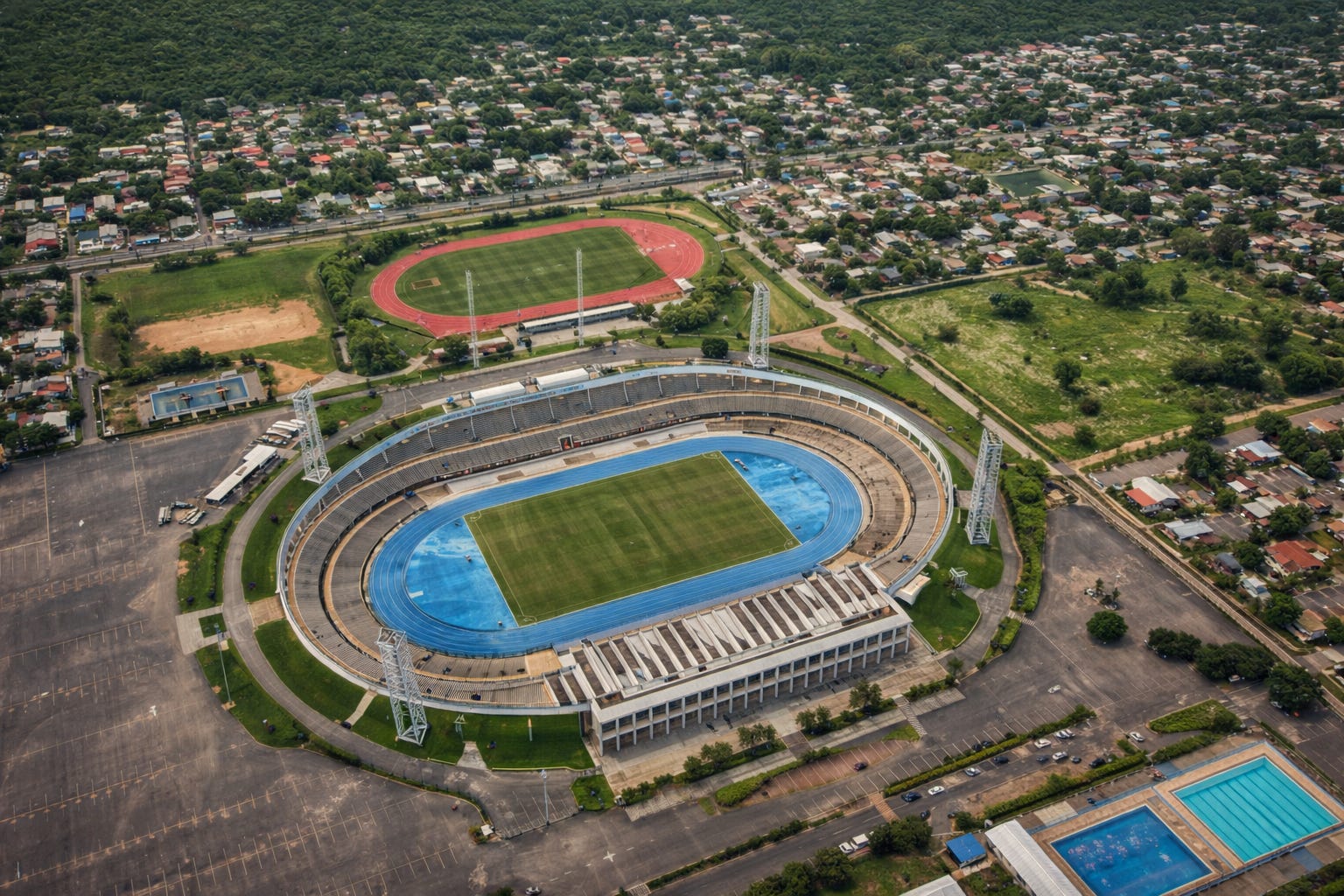
The story of Independence Park is not simply the story of a landscaped space with a stage and open lawns. It is something more layered than that, something that has grown quietly alongside the parish itself, shaped by memory, movement, and the steady rhythm of community life in St. Elizabeth. You can stand there on an ordinary afternoon and think it is just a park, but give it a little time and it begins to reveal itself as a kind of living canvas, one that has absorbed decades of culture, celebration, and change.
To understand Independence Park, you have to step back, not just to its formal establishment, but to the wider story of the parish. St. Elizabeth has long been known as Jamaica’s breadbasket, a place where the land itself seems to carry a certain generosity. Long before any formal park was laid out, this was a landscape of provision, of small farmers, of markets, of quiet industry. The cultural life of the parish grew from that soil, informal at first, gatherings under trees, music played in open yards, exhibitions improvised from what people had to hand.
As Jamaica moved towards independence in the early 1960s, there was a shift in thinking about public space across the island. There was a desire, subtle but determined, to create places that reflected not just colonial order but Jamaican identity. Independence Park emerged within that context, not as a grand gesture, but as something practical and rooted. A place where people could gather, where culture could be expressed openly, where the parish could, in its own way, present itself.
The name itself carries a quiet weight. It echoes the moment of Jamaican Independence, when the island stepped into self governance and began shaping its own narrative. In that sense, Independence Park is not just a location, it is part of a wider architectural language of nationhood, where spaces are given meaning beyond their physical boundaries.
Over time, the park became known for its horticultural shows, and there is something rather fitting about that. In a parish defined by agriculture, the act of gathering to display flowers, crops, and carefully cultivated plants feels almost inevitable. These shows are not simply about aesthetics. They are about pride, about knowledge passed down through generations, about the quiet expertise of people who understand the land in a way that does not need to be announced. Rows of blooms, arranged with care, become a kind of conversation between past and present.
But the park does not sit still in that identity. As the decades pass, it stretches, adapts, and accommodates. Stages are set, speakers rise, and suddenly the space shifts from quiet garden to vibrant performance ground. Music festivals fill the air, from traditional rhythms to modern sounds, each echoing across the lawns and out into the surrounding community. Art exhibitions appear, sometimes formal, sometimes improvised, but always reflective of a parish that has something to say.
There is a certain honesty in the way the park functions. It does not try to be overly polished or distant. It remains accessible, familiar. Families gather there not just for events, but for the simple act of being together. Children run across the grass without ceremony. Conversations unfold under the shade. Visitors arrive and, within moments, feel less like outsiders and more like participants in something ongoing.
And perhaps that is where its real significance lies. Independence Park is not defined by any single event or feature. It is defined by repetition, by the way it continues to host, to welcome, to provide a stage for expression. It becomes a place where the parish rehearses its identity again and again, each event adding another layer, another memory.
There is also a quiet contrast at work. On one hand, the park is alive with activity, colour, and sound. On the other, it offers stillness. In the early morning or late afternoon, when the crowds have gone, it becomes something else entirely. The landscaping, carefully maintained, reveals itself. Paths, lawns, trees, all arranged with a kind of understated intention. It is then that you realise the space has been designed not just for spectacle, but for pause.
In many ways, Independence Park mirrors the broader story of St. Elizabeth itself. A place grounded in tradition, yet open to change. A place where creativity does not need to announce itself loudly, because it is already embedded in daily life. It is not a monument in the conventional sense. It does not impose. Instead, it invites.
And so, over the years, it has become a symbol, not through declaration, but through use. A symbol of cultural pride, certainly, but also of continuity. Of a parish that understands the value of gathering, of celebrating, of creating space for both expression and reflection.
If you were to describe it simply, you might say it is a park that hosts events, a green space for community life. But that would miss something essential. Because Independence Park is not just where things happen. It is where the identity of a place is quietly shaped, tested, and shared, again and again, under open sky.