1494 – Christopher Columbus arrives on these lush shores, the island bathed in an intoxicating mix of heat, salt air, and untapped promise. The indigenous Arawaks, custodians of the land for centuries, would soon face the tragic consequences of European contact — a pattern repeated across the Americas.
1509 – The Spaniards arrive in earnest, bringing African slaves and planting the seeds — quite literally — of the sugar industry. The land begins its long dance with monoculture: fertile, lucrative, but devastatingly dependent on the global whims of price and politics.
1655 – The British arrive with military precision. From here, Jamaica becomes a cornerstone of the sugar empire. The island’s topography — from coastal plains to rich alluvial valleys — is perfect for agriculture, but the wealth flows away, and the architectural landscape remains starkly utilitarian.
1692 – Port Royal, the Caribbean’s own Sodom and Gomorrah, is swallowed by the sea in an earthquake. Here’s a lesson for the modern investor: no matter the era, location is everything — but nature will always have the final say.
1838 – Slavery is abolished. The sugar estates begin to fragment, labour changes, and with it, patterns of land ownership. Freedmen seek to own small plots — the first glimmer of Jamaica’s enduring love affair with “land as legacy.”
Real Estate Trend Note:
If you’d invested in fertile agricultural land in the 1830s and adapted to the post-slavery labour market, you could have cornered the emerging smallholder boom. The mid-19th century saw a slow but steady climb in rural property demand, though infrastructure was still painfully limited.
1865 – The Morant Bay Rebellion. Tensions over land and opportunity boil over. Britain tightens control, but the demand for self-governance grows.
1870s–1880s – Bananas step in where sugar falters. Coastal properties near ports gain value — Kingston begins to edge toward its modern role as the nation’s economic heart.
1938 – Riots erupt, partly economic, partly political. Out of this comes the People’s National Party. For real estate? Urban demand rises slowly, as migration to Kingston accelerates.
1944 – Universal suffrage. More Jamaicans now have a say in how the country is run — a subtle but powerful boost to domestic market confidence.
Real Estate Trend Note:
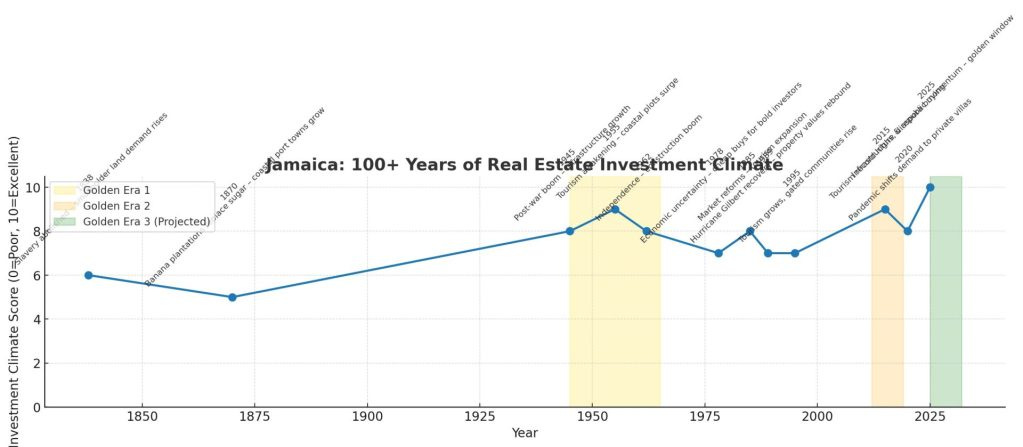
Post-war years (1945–1960) marked one of Jamaica’s first true investment booms. Infrastructure improved, roads linked rural and urban areas, and Kingston expanded dramatically. Coastal resort towns like Montego Bay and Ocho Rios began to awaken to tourism — if you’d bought coastal plots in the early ’50s, your grandchildren could be living off the returns today.
1962 – Independence. Optimism soars. Construction booms — not just homes, but hotels, government buildings, and the type of private villas designed to frame that Caribbean sea view like a postcard.
1970s – Michael Manley’s socialist policies shift the economy toward self-reliance. Nationalisation changes the investment climate: some foreign owners sell quickly; local investors can snap up bargains. Inflation, however, bites hard.
Real Estate Trend Note:
If you were bold — and had cash — the late 1970s offered some of the cheapest high-potential property deals in modern Jamaican history, especially in tourism corridors. The catch? You needed the patience (and resilience) to ride out political uncertainty.
1980s – Edward Seaga’s market-oriented reforms woo foreign capital. US aid flows in. Kingston’s commercial districts grow taller; the North Coast’s hotel strip blossoms. But crime begins its long shadow.
1988 – Hurricane Gilbert. Thousands of homes destroyed. Short-term chaos — but post-rebuild, property values in unaffected areas leap. A stark reminder: disaster recovery can be a catalyst for capital growth.
1990s – PJ Patterson’s era. Economic turbulence, but steady tourism growth. Crime rates weigh on investor confidence. Urban gated communities begin to take off — a model that will later define parts of Jamaica’s luxury market.
2000s – Hurricanes and global recessions jostle the market. Yet, Montego Bay airport’s expansion, cruise ship arrivals, and resort developments keep the hospitality sector buoyant.
2010s – Cannabis decriminalisation, cultural tourism, and diaspora returnees create new demand. Tech infrastructure improves; international schools expand — all markers of a maturing market.
Real Estate Trend Note:
Between 2012 and 2019, before the pandemic, was arguably the best decade for safe, high-yield Jamaican property investment since the 1950s. Tourism records broke annually, the dollar was relatively stable, and demand for both luxury villas and affordable housing surged.
2020 – The pandemic halts tourism overnight. But in a twist, demand for private, self-contained properties with gardens and space to work remotely rises. Coastal real estate for long-stay foreigners becomes hot again.
2022 – The Republic conversation gains traction. Political stability, coupled with a push for national self-definition, subtly boosts investor confidence — particularly among diaspora Jamaicans.
So… When’s the Next Best Time to Invest?
If history teaches us anything, Jamaica’s property market thrives during three key conditions:
Diaspora Return Waves – When overseas Jamaicans feel confident about returning.
Tourism Growth Spurts – When global conditions make the Caribbean the “it” destination.
Infrastructure Surges – New roads, airports, ports.
Right now, in the mid-2020s, we’re on the cusp of all three. The Montego Bay bypass, planned airport expansions, the cruise sector’s rebound, and a possible republic transition create a cocktail of optimism. Prices are climbing, but compared to the growth potential over the next decade — particularly in the North Coast, South Coast eco-tourism corridor, and emerging urban hubs like Mandeville — we’re still in the early innings.
Property weather chart” — over 100 years of Jamaica’s investment climate, with three golden windows marked: the post-war boom (1945–1965), the tourism surge (2012–2019), and the projected sweet spot (2025–2032).
Our prediction? 2025–2032 could be remembered as one of the most lucrative windows for Jamaican property investment in the past 100 years. But as ever, it’s not just what you buy — it’s where, when, and how you build.
Jamaica’s timeline is a story of resilience, reinvention, and the quiet, patient growth of value in land and place. Like a truly great Grand Designs project, it’s been messy, unpredictable, and often hard-fought — but when you step back and see the view, it’s utterly worth it.
Disclaimer: This timeline, commentary, and investment climate chart are provided for informational and educational purposes only. They do not constitute financial, legal, or real estate advice. Past performance of the Jamaican property market — including identified “golden windows” — is not a guarantee of future results. Property values can go down as well as up, and returns can be affected by political changes, economic instability, environmental events, and other unforeseen circumstances. Readers should seek independent professional advice from qualified real estate, financial, and legal experts before making any property investment decisions. The author accepts no liability for any loss or damage arising from reliance on the information contained herein.