


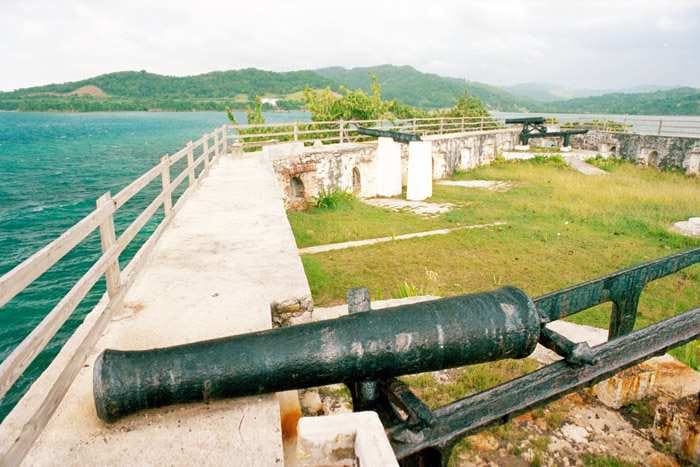
Fort Charlotte is a historic British fort located in Lucea, Hanover Parish, Jamaica. Constructed in the mid-18th century during the reign of King George III, it was named in honor of Queen Charlotte, his wife. This fort was strategically built to protect Jamaica’s North North-Westerly region from potential naval threats, especially given the island’s vulnerability along its northern coastlines. Designed with a barracks that could accommodate 50 soldiers, Fort Charlotte also featured 23 embrasures—openings through which guns could be fired—20 of which were mounted, providing substantial firepower.
During the Napoleonic Wars, it became evident that additional defenses were required to adequately safeguard the harbor. As a result, in 1807, three 24-pound cannons on traversing carriages were added to the seaward side, significantly enhancing the fort’s capacity for coastal defense. Architecturally, Fort Charlotte was built from rectangular cut stones and designed with multiple openings facing the sea, allowing for wide-ranging artillery coverage. Inside the fort, remnants of a circular gun base can still be seen, showcasing the innovative design that allowed artillery to pivot for firing in multiple directions. The artillery storehouse, constructed from solid cut stone with buttresses and a gable-ended roof, still stands today as a testament to the fort’s enduring structure.
Interestingly, part of Fort Charlotte now forms a section of Rusea’s High School, integrating this historical site into the local community. As a preserved landmark, Fort Charlotte offers a unique glimpse into Jamaica’s colonial past, British military architecture, and the strategic importance of coastal defenses during the era of European colonial expansion. Its combination of historical significance and adaptive reuse reflects Jamaica’s commitment to honoring and preserving its heritage.