

Jamaica, Africa, and the Question of Scale: Land, Faith, Property, and the Future

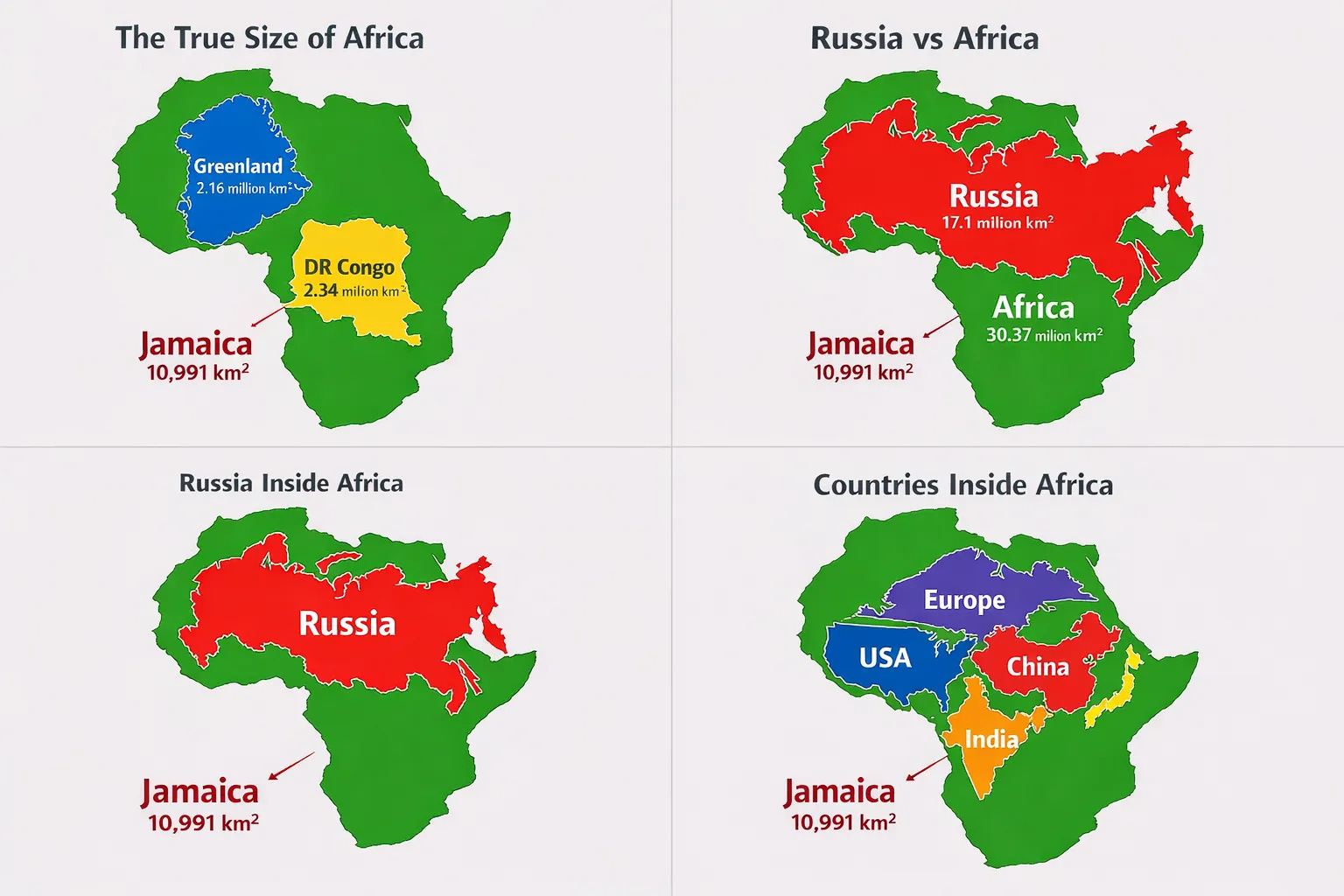
Jamaica has always lived with a double consciousness. On the one hand, it is a small island — 4,244 square miles, easily crossed in a day, intimate in scale, where everybody knows somebody who knows you. On the other hand, Jamaica’s story is vast. It stretches across oceans, centuries, belief systems, trade routes, empires, and continents. At the heart of that larger story sits Africa — not as an abstract idea, but as a physical, cultural, spiritual, and historical reality that continues to shape Jamaican life in ways we often underestimate.
One of the most powerful symbols of that underestimation is something deceptively simple: maps.
Africa, Scale, and the Stories We Are Taught
For generations, Jamaicans — like most people — have grown up seeing maps where Africa appears only slightly larger than Greenland, not much bigger than Europe, and sometimes seemingly comparable to North America. Those images quietly shape perception. They tell an unspoken story about power, importance, and relevance.
The reality is radically different. Africa is enormous. It is so large that the United States, China, India, Japan, and most of Europe can almost fit inside it at once. Several African countries alone are larger than many European nations combined. This is not just trivia. Size influences how we imagine economic potential, cultural reach, population dynamics, and future opportunity.
When Africa is visually shrunk, its historical role is minimized. When its role is minimized, the descendants of Africa across the diaspora — including Jamaicans — inherit a smaller sense of possibility.
Understanding Africa’s true scale is not about exaggeration or pride for pride’s sake. It is about correcting a distortion that has consequences.
Jamaica and Africa: More Than Ancestry
Jamaica’s connection to Africa is often framed narrowly: ancestry, enslavement, survival. While that history is essential, it is incomplete if it ends there.
Africa was not merely the origin point of forced migration; it was the source of systems — agricultural knowledge, spiritual frameworks, architectural logic, land-use practices, communal governance, and trade. These systems did not disappear on Jamaican soil. They adapted.
From the way land was shared in Maroon communities, to the rhythms embedded in worship, to the deep respect for burial grounds and ancestral property, African ideas about land and spirit survived — even under brutal suppression.
This matters deeply when we talk about real estate and development today.
Land Is Not Just Land in Jamaica
In Jamaica, land is never neutral. It is emotional. It is spiritual. It is political. It is generational.
This mirrors African land philosophy, where land is not merely a commodity but a trust — something borrowed from ancestors and held for descendants. Ownership, in this view, carries responsibility. You do not simply “flip” land; you steward it.
Yet modern Jamaican real estate increasingly operates within global investment frameworks that treat land as a product first and a place second. Resorts, gated communities, short-term rentals, and speculative holdings are often justified purely in terms of economic growth.
The tension between these two views — land as inheritance versus land as asset — is one of the defining challenges of Jamaica’s future.
Understanding Africa’s true scale reminds us that Jamaican land questions are not isolated. Across Africa, similar struggles play out: foreign ownership, extractive investment, displacement, and the pressure to monetize land without losing soul. Jamaica is not unique in this — it is connected.
Religion as the Bridge Between Africa and Jamaica
Christianity is deeply woven into Jamaican life. Churches sit on almost every corner, from hillside chapels to mega-sanctuaries. Faith shapes language, music, morality, and community structure. But Christianity in Jamaica is not identical to Christianity in Europe.
It absorbed Africa.
African spirituality emphasized the unseen, the ancestors, dreams, prophecy, healing, rhythm, and collective worship. These elements did not vanish when Christianity arrived. They reshaped it.
This fusion has implications for how Jamaicans think about land and home. Churches are often built on donated land. Family plots surround places of worship. Graveyards sit next to sanctuaries. Property and faith overlap physically, not just symbolically.
In Africa, religious institutions have long been landholders, educators, mediators, and economic anchors. Jamaica inherited this model. When we talk about church land, church-owned housing, or faith-based development today, we are continuing a centuries-old African pattern — whether we name it or not.
Real Estate, Identity, and Power
Modern Jamaican real estate sits at a crossroads.
On one side is opportunity: diaspora investment, tourism demand, urban renewal, infrastructure growth, and global attention. On the other side is risk: displacement, pricing out locals, cultural erosion, and land concentration.
Africa’s size — and its long experience with external interest — offers lessons Jamaica would do well to study carefully.
Large African nations have learned, sometimes painfully, that development without local ownership leads to resentment, instability, and long-term inequality. The same risk exists in Jamaica if land policy prioritizes speed and foreign capital over community inclusion.
This does not mean rejecting investment. It means reframing it.
Africa’s scale teaches that strength comes from internal markets, regional integration, and long-term planning. Jamaica, though small, can apply the same logic: empower local buyers, protect family land, formalize informal ownership, and ensure Jamaicans are not spectators in their own housing market.
The Psychological Impact of Scale
There is also a quieter impact of understanding Africa’s true size: confidence.
When Jamaicans see Africa as vast, complex, and powerful rather than distant and diminished, it reframes identity. Jamaica becomes not a small outpost at the edge of the world, but a node in a global African story.
That shift matters for entrepreneurship, planning, and imagination. It affects how Jamaicans negotiate with investors, how policymakers set priorities, and how young people imagine their future.
A small island connected to a massive continent does not need to think small.
The Future: What Does Africa’s Reality Mean for Jamaica?
Africa’s population is young, growing, and increasingly urban. Its economies are diversifying. Its cultural influence is expanding through music, fashion, technology, and faith movements. Jamaica is already part of this exchange, whether through music, religion, or diaspora networks.
Real estate will play a key role in this future. Housing, land rights, church property, heritage sites, and community spaces will determine whether development strengthens Jamaica or hollow it out.
The lesson from Africa is clear: land decisions echo for generations.
Jamaica has the advantage of scale in another sense — governance. As a smaller country, it can act faster, test smarter policies, and protect what matters before it is lost. But that requires clarity about who we are and where we come from.
Correcting the map is not about geography alone. It is about correcting perspective.
Reclaiming the Big Picture
Africa’s true size challenges old narratives. Jamaica’s history challenges simple explanations. Together, they invite a more honest conversation about land, faith, ownership, and future possibility.
Jamaica does not need to imitate Africa, nor romanticize it. But it does need to recognize that many of the questions it faces today — about property, belief, development, and dignity — have been asked before, on a much larger stage.
When Jamaicans understand Africa not as a distant past but as a present reality — vast, complex, and still unfolding — Jamaica’s own future becomes clearer.
Not smaller.
Clearer.