


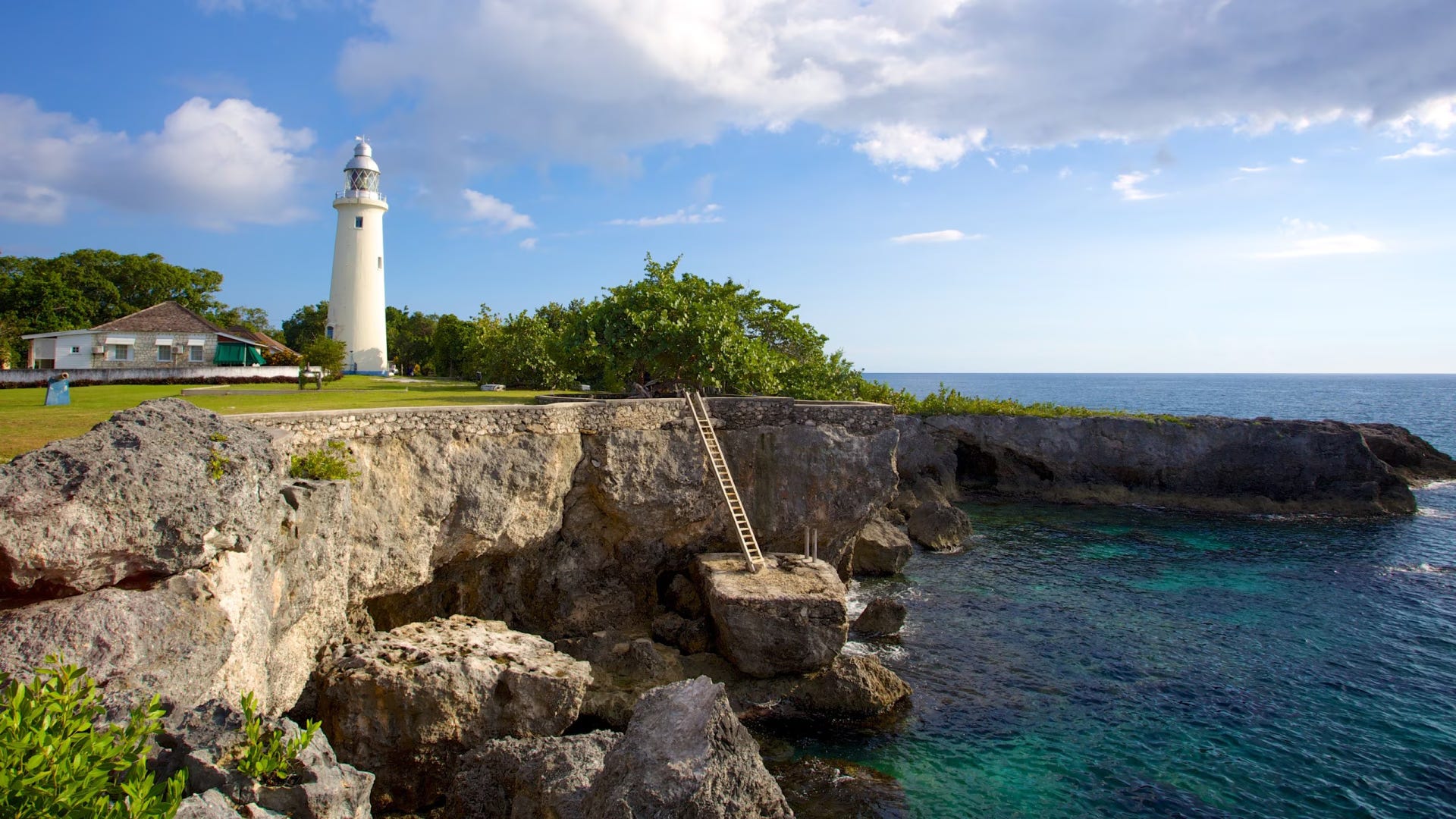
The Negril Point Lighthouse, situated at the southern tip of Negril Point on the extreme western end of Jamaica, is a notable maritime landmark that has guided ships and vessels along the island’s coastline for over a century. Standing at 66 feet above ground level, the lighthouse’s light is elevated 100 feet above sea level, offering a prominent visual aid to sailors navigating the waters of the Caribbean Sea. The tower, painted white to ensure visibility against the bright Jamaican sky, emits an automatic white light that flashes every two seconds, helping to mark the dangerous waters around Negril Point.
Constructed in 1894 by the French engineering firm Bubbler & Bernard, the Negril Lighthouse was built on a unique foundation— a 14-foot deep tank filled with water to keep the structure balanced and secure, particularly during seismic activity such as earthquakes. The cylindrical tower is built inland, with its elaborate light protected by a metal and glass enclosure and crowned with a wind-vane, which helps determine the direction of the wind to assist maritime navigation.
Originally powered by a gas lamp, the lighthouse underwent modernization in 1956 when it was converted to an acetylene gas lamp. This system served the lighthouse for several decades until 1985, when solar power was adopted, marking a significant step toward energy efficiency and sustainability. Today, the lighthouse continues to serve as an essential guide for maritime traffic, marking the westernmost point of Jamaica with its distinctive light. Located at latitude 18º 15′ north and longitude 78º 23′ west, the Negril Point Lighthouse remains an important piece of Jamaica’s maritime history and an iconic feature of Negril’s scenic coastline.