


There’s a story quietly unfolding in Jamaica’s property market — a story written not just in concrete, glass, and steel, but in the transactions of families, investors, and dreamers. Over the past decade, homes priced at JMD 60 million and above have shifted from rare curiosities to recurring fixtures in our urban corridors and coastal enclaves. It is a change that speaks volumes about wealth, ambition, and the shape of modern Jamaica.
Drawing on publicly available sales records spanning 2011 through mid-2025, this analysis filters for properties listed at JMD 60 million and up. What emerges is a fascinating narrative: a surge in luxury sales, clustering in a handful of postcodes and parishes, with Kingston still carrying the crown but coastal regions refusing to be left behind.
As always with such data, a word of caution: the information relies on human entry, and mistakes are inevitable. Figures in the hundreds of millions are likely correct; entries climbing into the billions may be typographical outliers. But when we strip away the noise, the signals are undeniable.
The Shape of a Market in Motion
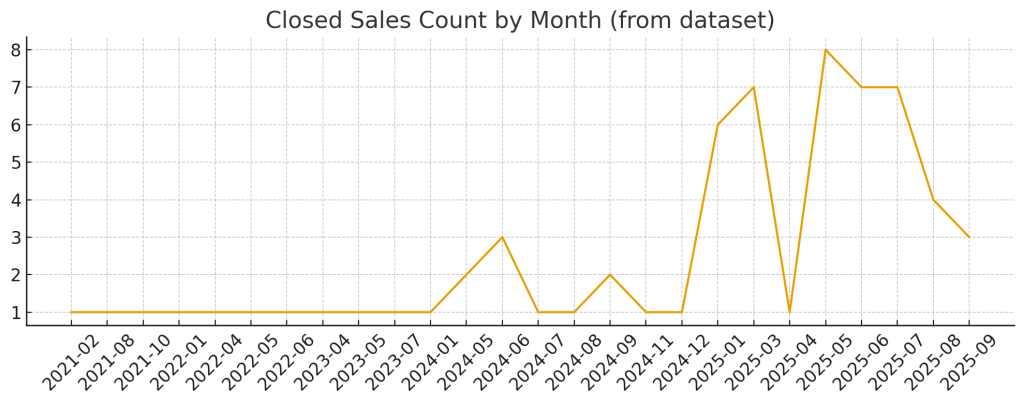
A decade ago, Jamaica’s “ultra” price bracket was thin. In 2015, only 21 qualifying sales breached the JMD 60M barrier. Fast forward to 2024, and the figure had ballooned to 160. That’s a 662% increase in less than ten years.
This isn’t a market built on hype or short-term froth. The volume of transactions has climbed steadily, suggesting genuine appetite rather than isolated spikes. Even the pandemic years didn’t derail the march upward — if anything, remote work, global mobility, and pent-up local demand gave the high-end sector fresh impetus.
Dean Jones, founder of Jamaica Homes, observes:
“What we’re seeing is not just an increase in numbers, but a cultural shift. Jamaicans are no longer thinking only in terms of shelter. They’re thinking in terms of legacy, investment, and lifestyle. A JMD 100 million home today is not a luxury trophy — it’s a strategic choice.”
Kingston: Still the Beating Heart
If there is one place where the dataset sings the loudest, it is Kingston. The city’s established enclaves — Kingston 6 and Kingston 8 — dominate the record counts. Together, they account for over 428 transactions above JMD 60M, with average prices hovering just above JMD 105 million.
In Kingston 6, leafy avenues, embassies, and established schools sustain buyer confidence. Kingston 8, slightly more suburban, offers space and newer builds, drawing families and professionals alike. These are not just homes; they are signifiers of status and stability.
The volume here also reflects liquidity. High-value homes sell, and they sell often. That’s crucial for a market where perception is half the battle. A lone estate on a hill may carry prestige, but when buyers see hundreds of transactions at similar levels, they know they’re investing in a proven corridor.
The Coastal Counterpoint
Still, Kingston no longer monopolizes the high-end stage. The coastal parishes are steadily rewriting the script.
Hanover leads by average sale price, topping JMD 121 million. Think exclusive villas near Tryall and developments stretching west of Montego Bay.
Portland follows with JMD 112 million, carried by boutique luxury properties in places like Port Antonio, where privacy and natural beauty drive premiums.
St. James (home to Montego Bay) boasts 63 high-value records, averaging JMD 106 million. The mix here includes resort-villa sales, retirement properties, and second homes catering to the diaspora and foreign investors.
Even St. Elizabeth surprises, clocking in with an average of JMD 112 million. As South Coast projects mature, its reputation as a “hidden gem” no longer feels like a well-kept secret.
This duality — Kingston’s steady dominance paired with coastal growth — suggests Jamaica’s market is maturing into a two-headed giant: one urban, one resort-driven. Both are buoyed by external and internal capital.
Outliers and Icons
Among the thousands of rows in the dataset are some standout sales. In 2014, for instance, a Wilmington Drive property in Kingston 6 recorded a price just above JMD 317 million. In St. Mary, a Tower Isle listing breached JMD 301 million. At the very top end, several estates touched the JMD 700 million range, although caution is warranted — in some cases, billion-dollar entries almost certainly reflect mis-keyed figures rather than actual closings.
Nevertheless, these headline numbers serve their purpose. They remind us that Jamaica, though a small island, plays on a global stage of luxury property. When a Port Antonio cliffside villa can rival the price per square foot of a Malibu retreat, it tells us buyers are not just chasing shelter but something rarer: a story tied to place.
Reading the Signals
So what do these patterns mean?
Liquidity attracts liquidity. Buyers are drawn to corridors with proven demand. Kingston 6/8 dominate not simply because they’re desirable, but because the constant churn reassures both sides of the transaction.
Coastal luxury is real, not speculative. With consistent high averages in Hanover, Portland, and St. James, this isn’t about one-off billionaire villas. It’s about a sustained appetite for lifestyle property.
New builds matter. Where the dataset records build years, newer homes often command the higher brackets. Jamaica’s luxury market is no longer anchored to old estates; it is increasingly defined by modern designs, gated communities, and international-standard finishes.
Diaspora demand continues. Many high-value sales appear in postcodes and parishes popular with overseas Jamaicans returning for part-time or retirement living. Currency differentials make a JMD 100 million property competitive against foreign benchmarks.
Voices from the Ground
Jones, reflecting on both data and lived experience, notes:
“The beauty of this market is in its diversity. On one hand, you have families in Kingston stretching to secure a foothold in a proven neighborhood. On the other, you have diaspora buyers in Portland, happy to pay for tranquility and ocean views. It’s not a single story — it’s many stories converging.”
Geography: where the money is
From the cleaned dataset, these parishes and postcodes emerge as the key centers of high-end transactions:
Most expensive parishes (by average sale price, filtered to ≥ JMD 60M)
(Top ten by average price; figures are averages of the cleaned price field in the uploaded file.)
Hanover — highest average among parishes (average ≈ JMD 121,810,100).
St. Elizabeth — average ≈ JMD 112,872,800.
Portland — average ≈ JMD 112,096,800.
St. James — average ≈ JMD 106,492,900.
St. Andrew — average ≈ JMD 101,408,600.
St. Mary — average ≈ JMD 97,980,640.
Trelawny — average ≈ JMD 96,786,810.
Manchester — average ≈ JMD 89,554,480.
Westmoreland — average ≈ JMD 84,457,340.
St. Ann — average ≈ JMD 82,998,350.
Post codes with the most high-value sales (count of ≥ JMD 60M transactions)
(Top entries by number of qualifying sales.)
Kingston 8 — the single most represented postcode in the high-value set (223 records). Average sale roughly JMD 103,900,900.
Kingston 6 — close behind (205 records). Average sale roughly JMD 107,507,400.
Montego Bay — high volume for St. James’ resort corridor (63 records).
Kingston 19 — another frequent code in the high-end set (43 records).
Taken together, Kingston 6 and Kingston 8 alone account for a very large share of high-value transactions in the file. That pattern indicates that, even as coastal and resort-area sales push up parish averages, the core Kingston corridors remain the workhorse market for high-value residential sales.
The Road Ahead
If the trajectory from 2015 to 2024 continues, Jamaica could see 200+ transactions annually above JMD 60 million within five years. That would make high-value homes less an exception, more a recognized tier of the market.
Yet challenges remain. Infrastructure strains, title backlogs, and community concerns about access and affordability cannot be ignored. Luxury sales light up headlines, but they sit within a broader housing landscape where many Jamaicans struggle with affordability. Balancing the top end with policy attention to the middle and lower brackets is critical.
For now, though, the story of Jamaica’s high-value housing market is one of expansion and resilience. It reflects not just rising prices, but rising confidence. From Kingston’s leafy avenues to Hanover’s coastal villas, from Portland’s boutique retreats to St. Elizabeth’s newfound allure, the numbers suggest a nation no longer tentative about luxury but embracing it as part of its modern identity.
And like every good design journey, the next chapter promises to be as surprising as the last.
Disclaimer: This article is based on publicly available property sales data and independent analysis. While care has been taken to ensure accuracy, the information may contain errors due to human data entry, incomplete records, or reporting anomalies. Figures should be interpreted as indicative, not definitive, and should not be relied upon as a substitute for official property records or professional financial advice.