
Judicial System in Jamaica
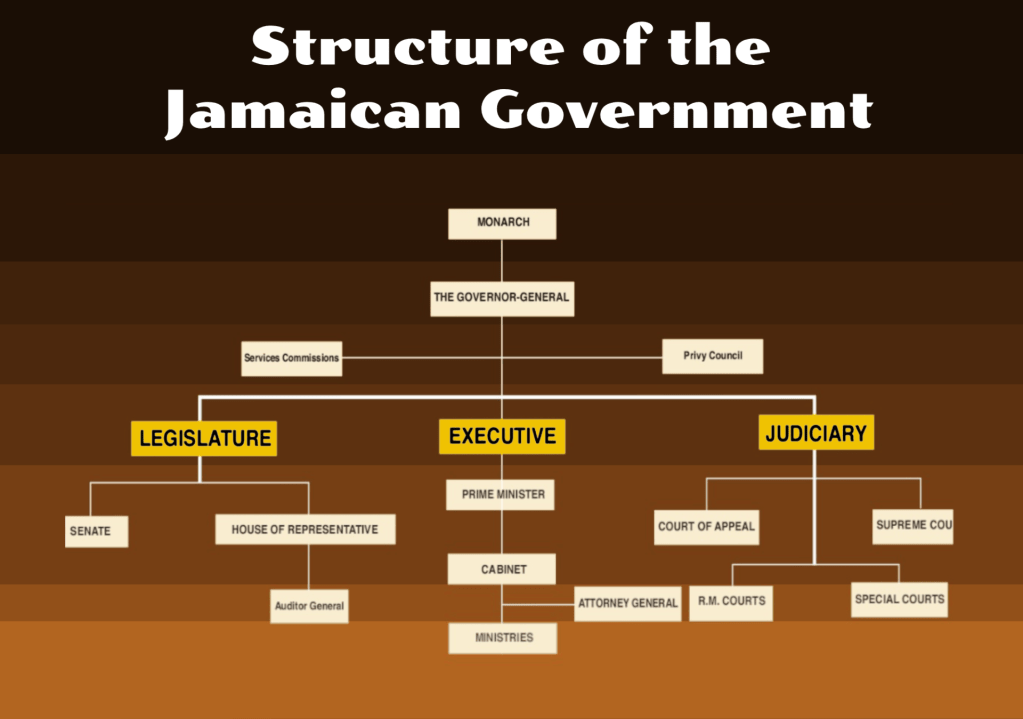
1. The Monarch
At the apex of Jamaica’s governmental structure is the MonarchIn Jamaica, the role of the Monarch, though primarily ceremonial, carries historical significance and reflects the count... More, a ceremonial position that links JamaicaJamaica, with its vibrant culture and stunning landscapes, has a unique position in the global real estate market. The i... More to its colonial past. The current Monarch is the King or Queen of England. While the Monarch’s role is largely symbolic, it represents the unity and continuity of the state.
2. Governor-General
Representing the Monarch in Jamaica is the Governor-GeneralIn Jamaican real estate, the Governor-General represents the Monarchy and acts as the official representative of the Cro... More, who is appointed on the advice of the Prime MinisterIn Jamaica, a Minister is a senior government official responsible for overseeing a particular ministry or department. T... More. The Governor-General performs various ceremonial duties and acts as the de facto head of state in Jamaica. This role is critical in ensuring the stability and continuity of governance, embodying the ceremonial aspects of the government while maintaining a connection to the British CrownIn Jamaica, the term "Crown" refers to the sovereign authority of the state, embodied in the monarchy. It represents the... More.
3. Privy Council and Service Commissions
The Privy CouncilIn Jamaica, the Privy Council serves as the highest appellate court for the island, functioning as the final court of ap... More is the highest local court in Jamaica, serving as the final court of appealDefinition of the Court of Appeal in Jamaica The Court of Appeal in Jamaica serves as a pivotal appellate court that rev... More. It plays a crucial role in the judiciary by ensuring that justice is administered fairly and according to the law. Alongside the Privy Council, various Service Commissions oversee the functioning of government agenciesAgencies play a crucial role in Jamaica's development process, acting as the stewards and regulators of various aspects ... More, ensuring that they operate efficiently and effectively. These commissions monitor the performance of public servants and the implementation of government policies.
The Three Branches of Government
The Jamaican governmentJamaica is a member of the Commonwealth of Nations, a voluntary association of independent countries, many of which were... More is divided into three distinct branches: the Legislative, the Executive, and the Judiciary. This separation of powers is designed to provide checks and balances, ensuring that no single branch becomes too powerful.
Legislative Branch
The Legislative branch is responsible for making laws and is bicameral, consisting of the SenateThe Senate in Jamaica is integral to the legislative process, including the creation and modification of laws that impac... More and the House of RepresentativesThe House of Representatives in Jamaica plays a pivotal role in shaping the laws and policies that govern various aspect... More.
- The SenateIn Jamaica, the Senate serves as a vital component of the legislative process, influencing the real estate sector throug... More: The Senate, also known as the Upper HouseA house serves as a fundamental structure designed for residential living, providing shelter and a place for individuals... More, is comprised of 21 appointed members. The Governor-General appoints 13 members on the advice of the Prime Minister and 8 members on the advice of the Leader of the Opposition. The Senate reviews and debates proposed legislation, ensuring that it is in the best interest of the public.
- House of Representatives: The House of Representatives, or the Lower House, consists of 63 elected members. These representatives are elected every five years in general elections. The House of Representatives is responsible for initiating and passing legislation, which is then reviewed by the Senate. The Auditor GeneralIn Jamaica, the Auditor General plays a crucial role in overseeing the integrity of public sector real estate dealings. ... More operates below the House of Representatives, managing parliamentary budgets, policies, and overseeing the use of government funds and services.
Executive Branch
The Executive branch is responsible for implementing and enforcing laws. It is headed by the Prime Minister, who is the leader of the majority party in the House of Representatives. The Prime Minister is also currently serving as the Minister of PlanningIn Jamaica, the role of Minister of Planning is not a separate, standalone position but is included within the responsib... More for Jamaica. The structure of the Executive branch is as follows:
- Prime Minister: The Prime Minister is the chief executive officer of the government, responsible for overseeing the administration and implementing government policies.
- Cabinet: The Cabinet consists of ministers appointed by the Prime Minister, each responsible for different government departmentsGovernment departments in Jamaica play a pivotal role in the administration and regulation of real estate, managing ever... More and ministries. The Cabinet plays a vital role in decision-making and policyIn Jamaica, a policy represents a guiding principle or course of action adopted by governmental bodies, organizations, o... More formulation.
- Attorney GeneralIn Jamaica, the Attorney General holds a pivotal role in overseeing legal affairs and ensuring the proper administration... More: The AttorneyIn Jamaica, an attorney is a legal professional who provides expert advice, representation, and services related to vari... More General is the main legal advisor to the government and plays a crucial role in ensuring that the government’s actions comply with the law. Positioned between the Cabinet and the ministries, the Attorney General provides legal counsel and representation.
Judiciary Branch
The Judiciary branch is responsible for interpreting and applying the law. It operates independently of the Executive and Legislative branches, ensuring the rule of law is upheld.
- Court of Appeal: The Court of Appeal is the highest court within Jamaica, below the Privy Council. It reviews decisions from lower courts and ensures the correct application of the law.
- Supreme CourtThe Supreme Court of Jamaica is the highest court within the Jamaican judiciary, responsible for the most significant le... More: The Supreme Court handles serious criminal and civil cases, serving as the main trial court in Jamaica.
- Resident Magistrate CourtsIn Jamaica, the Magistrate Courts are fundamental in handling a variety of legal matters, including those pertaining to ... More and Special CourtsIn Jamaica, Special Courts are designed to address specific legal issues with expertise and efficiency, including those ... More: Below the Supreme Court are the Resident Magistrate Courts and Special Courts, which handle less serious cases and specific types of disputes. The Judiciary’s reach extends both within and outside of the government, ensuring justice is served across various sectors of society.
Development and Planning
DevelopmentIn Jamaica, the term "development" can refer to various contexts, each with its unique focus and implications. Real esta... More and planningPlanning in Jamaica involves managing land, resources, and infrastructure to support economic growth, social development... More in Jamaica are primarily shaped by the third level of government, involving various ministries and local authoritiesLocal authorities in Jamaica play a vital role in regulating and overseeing real estate transactions, including mortgage... More. These entities are responsible for formulating and implementing policies related to infrastructure, urban development, environmental preservation, and more.
Legislative Process
The process of creating new legislation in Jamaica is methodical and involves several stages to ensure comprehensive scrutiny and public participation. Here is an overview of how laws become laws in Jamaica:
- Drafting: The process begins with the drafting of a bill, which can be initiated by the government or a private member of the House of Representatives. The drafting process involves detailed research and consultation with relevant stakeholdersStakeholders in real estate are individuals or groups with a vested interest in a development project, each contributing... More to ensure the proposed legislation addresses specific issues effectively.
- First Reading: The bill is introduced in the House of Representatives, where it undergoes the first reading. During this stage, the bill is read out, and its objectives and provisions are outlined. There is no debate at this stage.
- Second Reading: The bill moves to the second reading, where members of the House debate its merits and implications. This stage allows for a thorough discussion and provides an opportunity for members to express their support or concerns.
- Committee Stage: Following the second reading, the bill is referred to a committee, where it undergoes detailed examination. The committee may make amendments to the bill based on the discussions and feedback received.
- Report Stage: The committee reports back to the House with any amendments. Members then review the revised bill and may debate further changes.
- Third Reading: The bill is read for the third time, and members debate its final version. A vote is taken, and if the majority supports the bill, it passes to the Senate for considerationIn Jamaican real estate, consideration refers to the value exchanged between parties in a contract, typically involving ... More.
- Senate Review: The Senate follows a similar process of readings, debates, and committee review. The Senate can suggest amendments or reject the bill. If the Senate makes amendments, the bill returns to the House of Representatives for approval.
- Royal Assent: Once both the House of Representatives and the Senate have approved the bill, it is sent to the Governor-General for royal assent. Upon receiving royal assent, the bill becomes law and is implemented accordingly.
Governance and Policy Implementation
The implementation of laws and policies in Jamaica involves various governmental agencies and departments. These entities work together to ensure that the laws are effectively enforced and that the policies achieve their intended outcomes. For example, planning policies related to urban development, environmental preservation, and infrastructure are managed by the Ministry of Planning and the Ministry of Local Government. These ministries collaborate with local authorities to oversee development projectsA project or projects, within the Jamaican context, refers to a planned endeavor undertaken to achieve specific goals or... More and ensure compliance with regulations.
Environmental laws, such as those for the preservation of trees and natural habitats, are enforced by agencies like the National Environment and Planning Agency (NEPAThe National Environment and Planning Agency (NEPA) is a pivotal entity established in Jamaica in 2001, designed to over... More). NEPA monitors compliance with environmental regulations and works to protect Jamaica’s natural resourcesNatural resources are materials and substances that come from the earth and are used by people to live and build things.... More.
Conclusion
The structure of the JamaicanThe term "Jamaican" encompasses the citizens of Jamaica and their descendants in the Jamaican diaspora, representing a d... More government is designed to ensure a balance of power, effective governance, and the rule of law. From the symbolic role of the Monarch to the practical functions of the Legislative, Executive, and Judiciary branches, each component plays a vital role in maintaining the stability and development of the country. The legislative process is thorough and involves multiple stages of scrutiny and debate, ensuring that new laws are well-considered and beneficial to society. The implementation of these laws and policies is managed by various governmental agencies, working together to achieve the nation’s development goals and improve the quality of life for all JamaicansJamaicans are a resilient and vibrant people with a deep-rooted history defined by courage, resistance, and cultural ric... More.
Table: Structure of the Jamaican Government
| Level | Entity | Role/Description | Year Put in Place | People’s View | How It Interlinks | Additional Details |
|---|---|---|---|---|---|---|
| 1 | Monarch | Ceremonial Head of State | 1962 (Independence) | Generally viewed as a symbolic figure | Represents historical continuity and links to the UK | The monarch’s role is largely ceremonial with no day-to-day governance responsibilities. |
| 2 | Governor-General | Representative of the Monarch | 1962 (Independence) | Viewed as a respected figurehead | Acts on behalf of the monarch, performing ceremonial duties | Appointed by the monarch on the advice of the Prime Minister. Signs bills into law and represents Jamaica at official events. |
| 3 | Privy Council | Highest local court | Before 1962 (Colonial era) | Seen as an essential part of the judicial system | Acts as the final court of appeal in Jamaica | Ensures justice is administered fairly and consistently across the country. |
| 4 | Service Commissions | Oversight of government agencies | Post-Independence (1962) | Generally positive, seen as necessary for accountability | Monitors the performance of public servants and government agencies | Ensures that government agencies operate efficiently and effectively. |
Detailed Explanations and Additional Information
Monarch
The Monarch is the ceremonial head of state, representing the historical and symbolic continuity of Jamaica. The current Monarch is the King or Queen of England, serving a role that includes various ceremonial functions, such as the opening of ParliamentIn Jamaica, Parliament plays a crucial role in shaping the regulatory and legislative landscape for real estate, influen... More and granting royal assent to bills passed by the Parliament.
Governor-General
Appointed by the Monarch on the advice of the Prime Minister, the Governor-General acts as the de facto head of state in Jamaica. The Governor-General’s responsibilities include performing ceremonial duties, signing bills into law, representing Jamaica at official events, and ensuring the continuity of governance.
Privy Council and Service Commissions
The Privy Council serves as the highest court of appeal in Jamaica, ensuring that justice is administered fairly and consistently. Service Commissions play a critical role in overseeing the performance of government agencies and public servants, maintaining efficiency and effectiveness within the government.
| Branch | Entity | Role/Description | Year Put in Place | People’s View | How It Interlinks | Additional Details |
|---|---|---|---|---|---|---|
| Legislative | Parliament | Bicameral legislative body | 1962 (Independence) | Viewed as the core of democratic governance | Responsible for making laws and policies | Consists of the Senate and the House of Representatives. |
| Legislative | Senate | Upper House of Parliament | 1962 (Independence) | Mixed views, seen as a check on the lower house | Reviews and debates legislation passed by the House of Representatives | Can amend or reject bills; 21 members appointed by the Governor-General on the advice of the Prime Minister and the Leader of the Opposition. |
| Legislative | House of Representatives | Lower House of Parliament | 1962 (Independence) | Seen as the main legislative body | Initiates and passes legislation, debates policies | Comprised of 63 elected members; directly represents the peopleThe people of Jamaica embody a spirit that is at once richly diverse and unbreakably unified, as captured by the nationa... More. |
| Legislative | Auditor General | Independent oversight | 1962 (Independence) | Viewed positively for ensuring transparency | Manages parliamentary budgets and policies, oversees government spending | Ensures transparency and accountability in government expenditure. |
Legislative Branch
The Legislative branch is a bicameral body consisting of the Senate and the House of Representatives. This branch is responsible for making laws, debating policies, and overseeing government expenditure.
- Senate: The Senate, or Upper House, has 21 appointed members. It reviews and debates legislation passed by the House of Representatives, and it can amend or reject bills.
- House of Representatives: The Lower House consists of 63 elected members who initiate and pass legislation. They debate and vote on proposed laws and oversee government budgets and expenditure.
- Auditor General: An independent body that manages parliamentary budgets and policies, ensuring transparency and accountability in the use of government funds.
Table: Structure of the Jamaican Government (Executive and Judiciary)
| Level | Branch | Entity | Role/Description | Year Put in Place | People’s View | How It Interlinks | Additional Details |
|---|---|---|---|---|---|---|---|
| 1 | Executive | Prime Minister | Head of Government | 1962 (Independence) | Viewed as a key political leader | Leads the government, implements policies | Leader of the majority party in the House of Representatives; currently also Minister of Planning. |
| 2 | Executive | Cabinet | Senior executive body | 1962 (Independence) | Seen as the decision-making core of the government | Responsible for decision-making and policy formulation | Comprised of ministers appointed by the Prime Minister; oversees ministries. |
| 3 | Executive | Ministries | Government departments | 1962 (Independence) | Generally seen as the implementing arms of government | Implement government policies and programs | Each ministry is headed by a minister; examples include Health, Education, National SecurityIn Jamaican real estate, security refers to assets pledged to back a loan or financial obligation. Typically, the proper... More. |
| 4 | Executive | Attorney General | Main legal advisor to the government | 1962 (Independence) | Viewed as a crucial legal figure | Provides legal counsel, ensures government actions comply with the law | Positioned between the Cabinet and ministries; the main legal advisor to the government. |
Detailed Explanations
Executive Branch
Prime Minister: Established in 1962 with Jamaica’s independence, the Prime Minister is the head of government and is viewed as a key political leader. The Prime Minister leads the government, implements policies, and is the leader of the majority party in the House of Representatives. The role interlinks with the Cabinet and ministries, overseeing the execution of government functions.
Cabinet: The Cabinet, also established in 1962, is seen as the decision-making core of the government. It consists of ministers appointed by the Prime Minister and is responsible for policy formulation and decision-making. The Cabinet interlinks with ministries to ensure policies are implemented effectively.
Ministries: These government departments implement policies and programs. Each ministry, headed by a minister, is an essential part of the government’s structure. Ministries are generally viewed as the implementing arms of government. Examples include the Ministries of Health, Education, and National Security.
Attorney General: The Attorney General, established in 1962, is the main legal advisor to the government and is viewed as a crucial legal figure. This role ensures that government actions comply with the law and provides legal counsel to the government. The Attorney General is positioned between the Cabinet and ministries.
Judiciary Branch
Court of Appeal: This is the highest court within Jamaica, established before 1962 during the colonial era. It reviews decisions from lower courts and ensures the correct application of the law. The Court of Appeal acts as the final court within the Jamaican judicial system and is viewed as an essential part of the judiciary.
Supreme Court: The Supreme Court, also established before 1962, is seen as the backbone of the judicial system. It handles serious criminal and civil cases, ensuring justice is administered according to the law.
Resident Magistrate Courts: These lower courts were established before 1962 and are viewed as accessible and essential for local justice. They handle less serious cases and serve as the initial point of contactIn the real estate realm, contact refers to the crucial communication point between parties involved in a transaction or... More for most legal disputes.
Special Courts: These specialized judicial bodies handle specific types of disputes, such as family or traffic cases. Their establishment varies by court, and they are seen as necessary for handling specific legal issues. Special Courts ensure that specialized legal processes and justice are administered.
Interlinking and Additional Details
The executive and judiciary branches interlink through various mechanisms to ensure governance and justice are administered effectively. The Prime Minister and Cabinet set policies and oversee their implementation through the ministries. The Attorney General provides the legal frameworkThe legal framework in Jamaica is the organized system of laws, regulations, and judicial processes that govern the coun... More and advice necessary for the government’s actions. Meanwhile, the judiciary ensures that these actions comply with the law through the courts, from the Supreme Court to the Resident Magistrate Courts and Special Courts.
These structures are foundational to Jamaica’s governance and legal systems, established during and after the country’s independence in 1962. They are viewed by the populace as essential components of democracy and justice, each playing a distinct yet interconnected role in the functioning of the government.
Table: Structure of the Jamaican Government (Judiciary Branch)
| Level | Branch | Entity | Role/Description | Year Put in Place | People’s View | How It Interlinks | Additional Details |
|---|---|---|---|---|---|---|---|
| 1 | Judiciary | Court of Appeal | Highest court within Jamaica | Before 1962 (Colonial era) | Viewed as an essential part of the judiciary | Reviews decisions from lower courts, ensures correct application of the law | Acts as the final court within the Jamaican judicial system. |
| 2 | Judiciary | Supreme Court | Main trial court | Before 1962 (Colonial era) | Seen as the backbone of the judicial system | Handles serious criminal and civil cases | Ensures justice is administered according to the law. |
| 3 | Judiciary | Resident Magistrate Courts | Lower courts | Before 1962 (Colonial era) | Viewed as accessible and essential for local justice | Handle less serious cases, first level of the judiciary system | Serve as the initial point of contact for most legal disputes. |
| 4 | Judiciary | Special Courts | Specialized judicial bodies | Varies by court | Seen as necessary for handling specific legal issues | Handle specific types of disputes like family or traffic cases | Ensures specialized legal processes and justice are administered. |
Detailed Explanations
Court of Appeal
- Role/Description: The highest court within Jamaica, responsible for reviewing decisions from lower courts and ensuring the correct application of the law.
- Year Put in Place: Before 1962 (Colonial era).
- People’s View: Viewed as an essential part of the judiciary.
- How It Interlinks: Acts as the final court within the Jamaican judicial system.
- Additional Details: The Court of Appeal ensures that justice is served consistently and fairly across the country.
Supreme Court
- Role/Description: The main trial court handling serious criminal and civil cases.
- Year Put in Place: Before 1962 (Colonial era).
- People’s View: Seen as the backbone of the judicial system.
- How It Interlinks: Ensures justice is administered according to the law.
- Additional Details: The Supreme Court has jurisdiction over significant legal matters, providing a robust legal framework for upholding the rule of law.
Resident Magistrate Courts
- Role/Description: Lower courts handling less serious cases and serving as the initial point of contact for most legal disputes.
- Year Put in Place: Before 1962 (Colonial era).
- People’s View: Viewed as accessible and essential for local justice.
- How It Interlinks: Handle less serious cases, forming the first level of the judiciary system.
- Additional Details: Resident Magistrate Courts provide a critical interface for the public with the judicial system, ensuring swift and localized justice.
Special Courts
- Role/Description: Specialized judicial bodies handling specific types of disputes, such as family or traffic cases.
- Year Put in Place: Varies by court.
- People’s View: Seen as necessary for handling specific legal issues.
- How It Interlinks: Handle specific types of disputes, ensuring specialized legal processes.
- Additional Details: Special Courts ensure that specialized legal matters receive the appropriate attention and expertise required for fair adjudication.
Discover more from Jamaica Homes
Subscribe to get the latest posts sent to your email.

Join The Discussion