
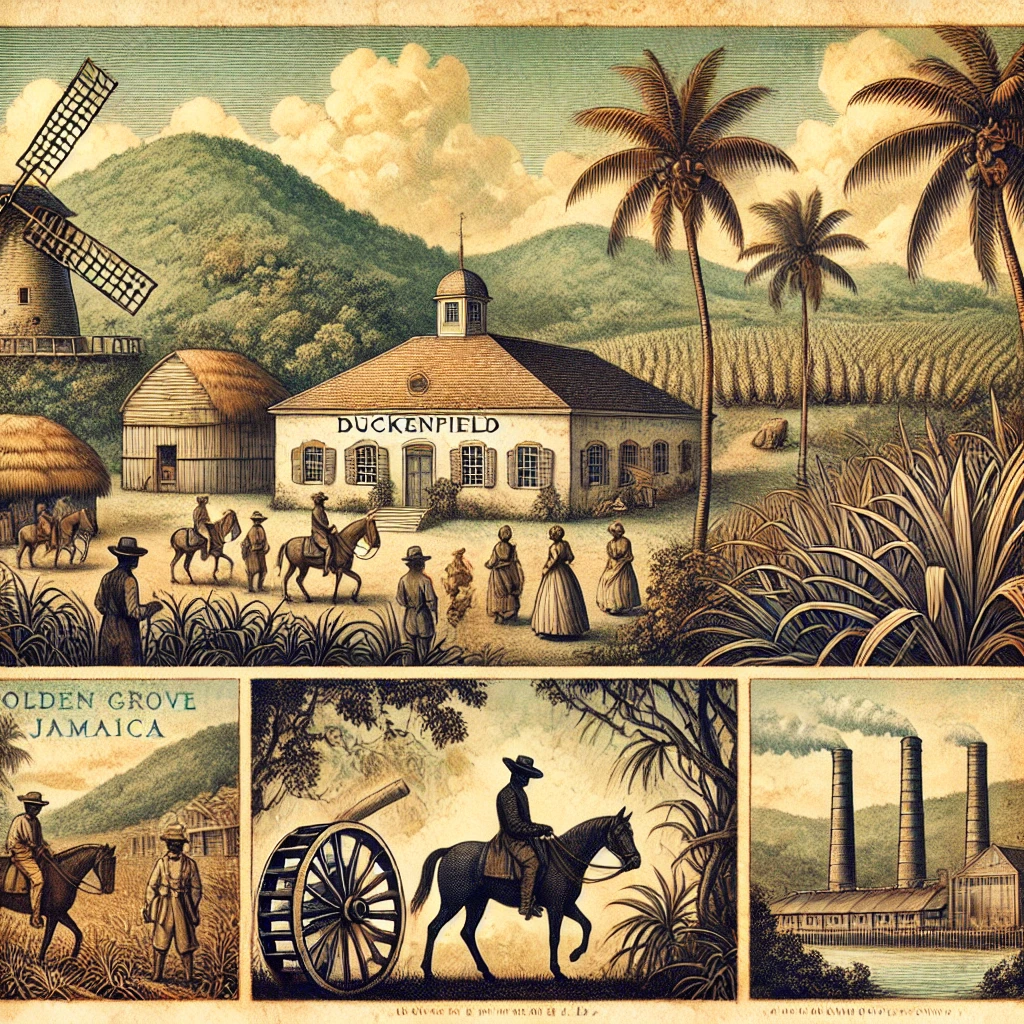
The history of DuckenfieldDuckenfield, located in Saint Thomas, Jamaica, has deep historical roots in plantation agriculture, particularly in suga... More, situated in Saint ThomasSaint Thomas is a parish situated on the southeastern coast of Jamaica, known for its picturesque landscapes and rich hi... More ParishIn Jamaica, a parish is a unique blend of community, culture, and history. Each of the 14 parishes serves as a local gov... More, JamaicaJamaica, with its vibrant culture and stunning landscapes, has a unique position in the global real estate market. The i... More, offers an even deeper understanding of the island’s colonial past and its transformation over time. As an area deeply entwined with the sugar industry’s rise, Duckenfield’s establishment and the significance of the Duckenfield family bring further depth to the discussion of Jamaica’s colonial-era dynamics.
Expansion and Economic Role in the 18th Century
The Duckenfield estateIn Jamaican real estate, an estate refers to the total collection of assets and property owned by an individual, especia... More played a pivotal role in the economic prosperity of the region. In the mid-1700s, the expansion of the sugar industry in Jamaica relied heavily on large estatesDuring the colonial era, large estates in Jamaica emerged as the cornerstone of the island's economy, profoundly shaping... More like Duckenfield. This period marked the apex of the island’s sugar production, which was driven by both local consumption and the export of sugar and rum to Europe and the Americas. As an essential part of Jamaica’s plantation economy, the success of Duckenfield Hall was also closely tied to global trade networks and the brutal systems of slave labor.
By 1754, Robert Duckenfield’s vast landholdings of over 5,000 acres were among the largest on the island, making him a prominent figure in the island’s economic and social circles. While this expansion was fueled by the sugar trade, it also made the Duckenfield family influential in local politics and society.
Slave Labor and the Plantation System
Like many plantations in Jamaica, Duckenfield Hall’s operation was reliant on enslaved peopleThe people of Jamaica embody a spirit that is at once richly diverse and unbreakably unified, as captured by the nationa... More. By the mid-18th century, the estate employed a significant number of enslaved individuals to maintain its sugar production. Records from 1757 show that the estate’s workforce consisted of 348 enslaved individuals, working in grueling conditions to cultivate and process sugarcane, as well as to produce rum. The infrastructure of the plantation included not just sugar mills but also distilleries and other facilities essential for the production of these goodsGoods refer to physical items produced for consumption or sale, encompassing a wide array of products from basic necessi... More.
The reliance on slaverySlavery in Jamaica, which began in the early 17th century following the island's colonization by the British, was a brut... More was a central feature of the colonial plantation economy, and Duckenfield Hall stands as a testament to how deeply this exploitation was embedded in the wealth of the time. The enslaved populationPopulation refers to the total number of people inhabiting a defined geographic area and encompasses their demographic, ... More at Duckenfield Hall, as well as other sugar plantations, were forced into labor under brutal conditions, contributing to the wealth of EuropeanEuropeans, in the context of Jamaica, real estate, and the global market, refer to individuals from the continent of Eur... More colonial powers, while reinforcing systemic inequalities that would persist throughout Jamaica’s history.
Family Dynamics and Social Hierarchies
The personal life of Robert Duckenfield adds another layer to the complex social fabric of colonial Jamaica. His relationship with Jane Engusson, a free woman of AfricanAfricans, in the context of Jamaica, real estate, and the broader world, represent individuals of African descent or tho... More descent, and their three children, William, Escourt, and Elizabeth, challenges the racial boundaries that were strictly enforced at the time. In an era where legal and social classifications were based heavily on race, Duckenfield’s petition in 1747 to grant his children the same privileges as white children is a remarkable example of the blurred lines of racial identity within colonial society.
This request, which was granted in 1752, speaks to the intersection of social, legal, and economic factors in colonial Jamaica. It also provides a glimpse into the privileges of a wealthy colonial planter who could manipulate the system in ways that were not available to most. This historical anomaly, where the children of an enslaved woman could gain status despite their racial heritageHeritage, in the context of Jamaica, real estate, and the rest of the world, refers to the tangible and intangible asset... More, highlights the complex and sometimes contradictory nature of colonial racial systems.
Decline of the Sugar Industry and Modern DevelopmentIn Jamaica, the term "development" can refer to various contexts, each with its unique focus and implications. Real esta... More
As the 19th century progressed, Jamaica’s sugar industry began to face significant challenges. The abolition of slavery in 1834, coupled with the decline in global sugar prices, led to the eventual collapse of many plantation estates, including Duckenfield. While the estate no longer operates as a functioning plantation, the remnants of Duckenfield Hall remain as historical landmarks, offering valuable insights into Jamaica’s colonial past.
The legacyLegacy, in the context of Jamaica, real estate, and the broader world, represents the enduring impact of past actions, a... More of Duckenfield Hall is also shaped by modern development. Today, the site holds both historical significance and cultural value, serving as a reminder of Jamaica’s complex history. The area surrounding the estate has undergone significant changes, with new generations moving into the region and new economic activities taking root. However, the deep connection between landownership, colonial history, and the dynamics of race and class continues to resonate in the area.
The present-day recognition of Duckenfield’s history is part of a broader effort to understand and reflect on Jamaica’s colonial past. While the sugar industry has long since faded, the history of plantations like Duckenfield is still integral to the island’s heritage.
Discover more from Jamaica Homes
Subscribe to get the latest posts sent to your email.

Join The Discussion