
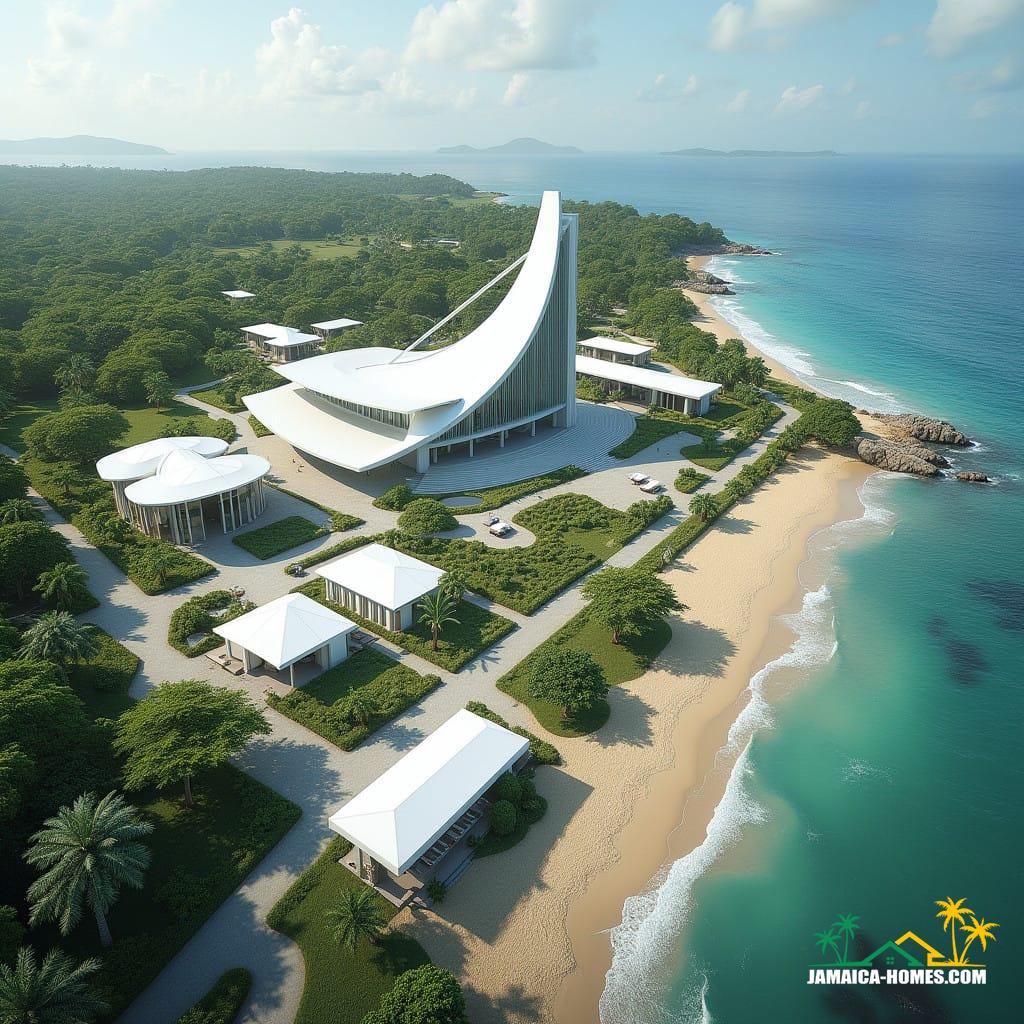
If you think of the CaribbeanThe Caribbean is a vast region made up of over 700 islands, islets, reefs, and cays. Some of the most well-known islands... More as a mosaic of islands, each with its own flavour, then JamaicaJamaica, with its vibrant culture and stunning landscapes, has a unique position in the global real estate market. The i... More is a piece that manages to be both timeless and ever-changing. Its architectureArchitecture is the art and science of designing and constructing buildings and spaces that reflect cultural, functional... More is as layered as its history, stitched together from SpanishThe Spanish first arrived in Jamaica in 1494, marking a significant European influence that shaped the island’s early ... More fortitude, British elegance, and a modern resilience born of island lifeIsland life is all about a special way of living that feels different from being in a big city. In Jamaica, island life ... More.
Here, the buildings don’t just exist — they narrate. They speak of conquest and creativity, of sugar and struggle, and of a peopleThe people of Jamaica embody a spirit that is at once richly diverse and unbreakably unified, as captured by the nationa... More who have always adapted their built environment to suit their climate, culture, and ambitions.
Much like a homebuyer walking through a propertyProperty encompasses a wide range of tangible assets that individuals or entities can own, utilize, or invest in, includ... More with “good bones” and a checkered past, Jamaica’s skylines invite you to look deeper — because what you see is only part of the story.
The Spanish Arrival — Foundations in Faith and Fortitude
In 1494, Christopher ColumbusIn 1494, Christopher Columbus arrived in Jamaica during his second voyage to the New World, forever altering the island'... More arrived, and with him came the first EuropeanEuropeans, in the context of Jamaica, real estate, and the global market, refer to individuals from the continent of Eur... More structures — thick-walled, Spanish-style buildings designed not for beauty alone, but for survival.
Take Halse Hall in ClarendonClarendon is a parish situated in central Jamaica, known for its diverse landscape that includes fertile plains and roll... More — a grand, two-storey plantation houseA house serves as a fundamental structure designed for residential living, providing shelter and a place for individuals... More whose thick limestone walls doubled as a defensive measure. This was architecture as armour, a statement that said: We’re here to stay.
By 1534, the Spanish had laid out VillaIn Jamaica, a villa is a prestigious type of residence known for its spaciousness, elegant design, and luxurious feature... More de la Vega — the island’s first capitalCapital refers to the financial resources, whether in the form of equity, debt, or other assets, that individuals or bus... More — modelled after Spanish settlements like New Seville. With its Governor’s residence, assembly house, and military barracks, all centred around a broad plaza, it was less a town and more a declaration of empire.
When the English took Jamaica in 1655, they simply renamed it Spanish TownSpanish Town is a historic town located in St. Catherine Parish, Jamaica, and was once the island's capital during the S... More, keeping the bones of the settlement but overlaying them with their own grid-like order and aesthetic. It remained the capital until 1872, when KingstonKingston, the capital city of Jamaica, embodies a dynamic fusion of historical depth and contemporary vitality. Establis... More took the crownIn Jamaica, the term "Crown" refers to the sovereign authority of the state, embodied in the monarchy. It represents the... More.
JamaicanThe term "Jamaican" encompasses the citizens of Jamaica and their descendants in the Jamaican diaspora, representing a d... More Georgian — The British BlueprintA blueprint serves as a detailed architectural plan or technical drawing, crucial in the real estate and construction in... More with an Island Twist
The 18th and early 19th centuries brought with them an era of architectural refinement: the Jamaican Georgian styleIn real estate, Georgian style refers to a classical architectural design characterized by its symmetry, proportion, and... More. Between the 1750s and 1850s, the English fused classic Georgian elegance — balustrades, lattices, wide staircases, pineapple finials — with practical adaptations for the tropics.
These homes weren’t just pretty; they were clever. Plantation houses sat on stilts for air circulation, keeping the interiors cool and discouraging unwelcome guests of the reptilian and rodent variety.
The style left its most visible mark in Kingston, but also in sugar-rich towns like Falmouth, whose courthouse is still a proud example of the period.
And then there’s Devon HouseDevon House: A Jewel of Jamaican History and Architecture Devon House, located in the heart of Kingston, Jamaica, stands... More — built in 1881 for George Stiebel, Jamaica’s first black millionaire. Sitting on 11 acres, this is no mere residence; it’s a manifesto in brick and mortar. Today, visitors can wander through its ballroom, drawing roomIn Jamaican Patois, the term "room" is commonly used to describe individual spaces within a property, offering a practic... More, and master suite — rooms that once hosted the conversations, deals, and dreams of Jamaica’s elite.
20th Century Statements — Strength, Style, and a Dash of Nostalgia
As the 20th century progressed, Jamaican architecture began to experiment again — this time with bold, fortress-like forms. Think PanJam Building in Kingston — Vayden McMorris’s creation with its tall, thick walls and modest windows, drawing on the island’s historic forts while embracing post-modernism.
Interestingly, many hotels along the north coast — from Ocho RiosOcho Rios is a popular resort town on Jamaica's north coast, known for its natural beauty, vibrant tourism industry, and... More to Runaway Bay — looked backwards, embracing Georgian revival designs courtesy of architects like H. Denny Repol in the 1960s. They may have been new, but they wore their heritageHeritage, in the context of Jamaica, real estate, and the rest of the world, refers to the tangible and intangible asset... More like a favourite linen shirt — light, comfortable, and familiar.
Curiosities and Character Properties
Some Jamaican buildings defy categorisation — much like those unexpected properties you find on a real estateReal estate refers to property consisting of land and the structures on it, such as buildings and homes. It also include... More listing, the ones with a “quirky charm” that either captivates or confounds.
In St Ann, you’ll find Edinburgh CastleEdinburgh Castle, nestled in the Pedro district of St. Ann, is a historical ruin with a dark and intriguing past. Constr... More — not a castleIn the realm of Jamaican real estate, a castle typically refers to an expansive and historically significant property ch... More at all, but a fortified residence built by Lewis Hutchinson, Jamaica’s first recorded serial killer. Its twin circular towers are crumbling now, but the intrigue they hold could fill a library.
Then there’s Roaring River Great HouseRoaring River Great House, located in St. Ann, Jamaica, is a remarkable example of how classical Georgian architecture w... More in WestmorelandWestmoreland is a parish located on Jamaica's southwestern coast, known for its scenic beauty and vibrant communities. T... More. The 17th-century plantation has faded into the background, overshadowed by the natural wonder of its underground river and the cool blue sinkhole you can swim in. It’s a reminder that in Jamaica, nature often outshines even the grandest man-made creations.
A Living Portfolio
Jamaica’s architecture is not a static museum collectionIn the context of Jamaica's real estate industry and the global market, "collection" typically refers to the process of ... More. It’s a living portfolio — from Spanish fortresses to Georgian elegance to modernist statements, each piece is a chapter in the story of a nation that has always built with purpose.
And if you’re in the business of property — whether buying, selling, or simply admiring — Jamaica offers something rare: homes and buildings that carry not just market valueMarket Value is the estimated amount for which an asset or liability should exchange on the valuation date between a wil... More, but historical weight. In real estateIn Jamaican real estate, an estate refers to the total collection of assets and property owned by an individual, especia... More terms, that’s called character. In human terms, it’s called soul.
DisclaimerA disclaimer is a statement that serves to limit or exclude liability, usually found in legal documents, websites, produ... More: This image is for illustrative purposes only. Actual locations, buildings, and details may vary. All rights reserved.
Discover more from Jamaica Homes
Subscribe to get the latest posts sent to your email.

Join The Discussion