


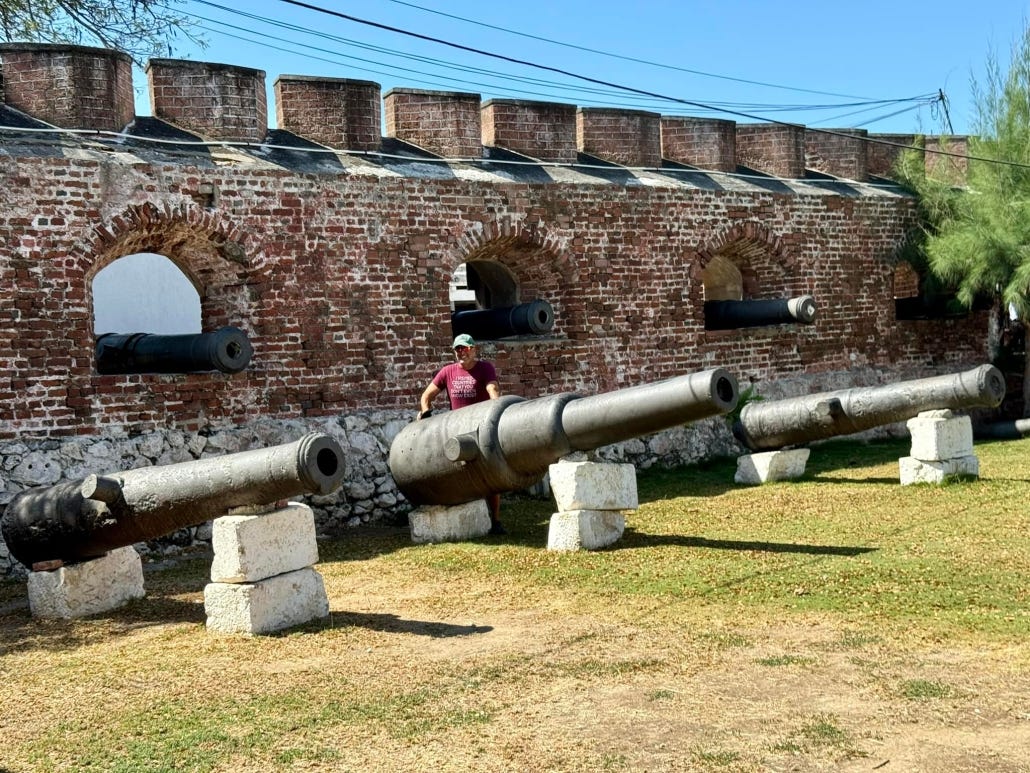
The Port Royal Forts were vital to Jamaica’s colonial defense, particularly for the city of Port Royal, once known as “the richest and wickedest city in the world.” Established by British settlers in the 1650s, Port Royal flourished as a bustling hub of trade and piracy. By the late 17th century, it was populated by a lively mix of merchants, craftsmen, soldiers, buccaneers, and pirates, with a population estimated at 8,000 to 10,000. The town’s streets were lined with multi-story buildings, shops, taverns, and other establishments, making it one of the most active and notorious ports of its time.
To protect this vital commercial center, the British constructed a network of forts, including Fort Charles, Fort Carlisle, and Fort James, strategically positioned to defend against foreign threats. This defense network was put to the test on June 7, 1692, when a catastrophic earthquake struck, causing much of Port Royal to sink into the sea and taking the lives of more than 2,000 residents. The earthquake, followed by a fire in 1703 and a hurricane in 1722, led to the town’s decline, as survivors established a new settlement across the harbor in Kingston. Today, the sunken remnants of Port Royal serve as an underwater time capsule, preserving the city much as it appeared in the 17th century.
Notable Forts of Port Royal
Fort Charles – Initially known as Fort Cromwell, Fort Charles was renamed in honor of King Charles II. As the town’s main defense, it was expanded over time and is now one of the few remaining forts open to visitors.
Fort Carlisle – Constructed in 1678 and named for Charles, Earl of Carlisle, this harbor-side fort featured 14 mounted guns. The 1692 earthquake ultimately destroyed it.
Fort James – Built in 1673 and named after the Duke of York, later King James II, Fort James featured a hexagonal design and 26 guns to protect the inner harbor. It, too, was lost to the earthquake.
Fort Morgan – Built between 1678 and 1680 to reinforce a vulnerable stretch between other forts, Fort Morgan held 26 guns and may have functioned as a continuous battery line along the shore, often referred to as “Morgan’s Line.”
Fort Rocky – Built much later, around 1888, Fort Rocky was designed to counter possible submarine attacks, equipped with 6-inch breech-loading guns. Its armament remained in place until the end of World War II.
Fort Rupert – Completed in 1678 with 22 guns, Fort Rupert defended Port Royal’s eastern side. Known as the “sea fort” after the English Revolution, it was also destroyed in the 1692 earthquake.
Fort Walker – The final fort built before 1692, Fort Walker, was completed in the 1680s and featured 18 guns. Positioned north of Fort Charles, it completed the defensive line surrounding Port Royal. Like others, it was destroyed by the earthquake.
These forts exemplify the British military’s efforts to secure Jamaica’s strategic port, providing a protective ring around Port Royal to prevent enemy access to its harbor. Despite the town’s eventual destruction by natural forces, Fort Charles remains preserved, offering a glimpse into Jamaica’s colonial past. The submerged ruins and remnants of the other forts continue to draw historical interest, encapsulating a rich chapter in Jamaica’s maritime history.
Summary of Port Royal Forts
Fort Charles
Fort Carlisle
Fort James
Fort Morgan
Fort Rocky
Fort Rupert
Fort Walker
References
Senior, Olive. A-Z of Jamaican Heritage. Kingston: Heinemann Educational Books Ltd, 1988.
Jamaica National Heritage Trust. “Notes on the History of Port Royal.” JNHT Research File.
Digital Commonwealth Archive. “Port Royal.”