


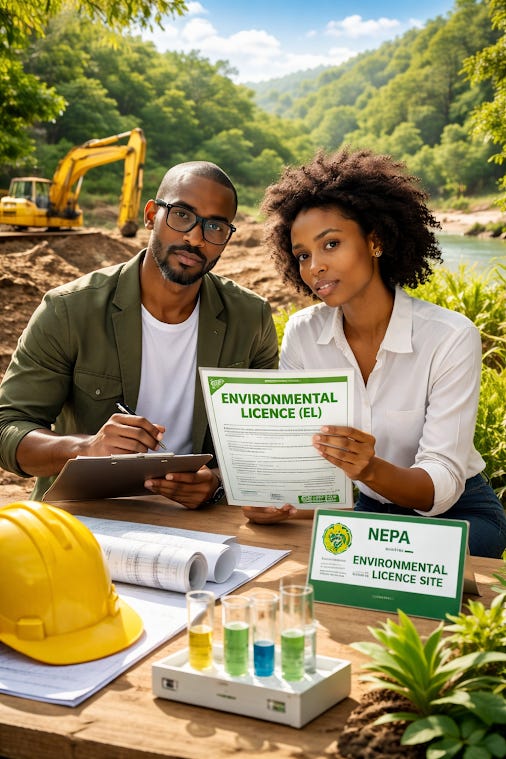
Environmental Licence (EL) in Jamaica refers to a formal authorisation granted by the state permitting an individual, company, or organisation to undertake activities that may have a measurable impact on the natural environment. It forms part of Jamaica’s broader environmental management and regulatory system, ensuring that development and industrial activity are conducted in a manner that safeguards ecological integrity, public health, and sustainable resource use.
In practical terms, an Environmental Licence is required for specific categories of projects or operations that pose potential environmental risks, including but not limited to waste management, industrial processing, mining, quarrying, energy generation, and large-scale infrastructure development. The licence sets out legally binding conditions under which such activities may proceed.
Institutional Framework
Environmental licensing in Jamaica is primarily administered by:
National Environment and Planning Agency
NEPA operates under the Natural Resources Conservation Authority (NRCA) framework and is responsible for:
Reviewing applications for environmental licences
Assessing environmental risks
Setting operational conditions
Monitoring compliance and enforcement
The authority to issue Environmental Licences is grounded in legislation such as the Natural Resources Conservation Authority Act and associated regulations.
Purpose and Scope
The Environmental Licence system exists to regulate activities that could:
Pollute air, water, or soil
Degrade ecosystems
Affect public health
Contribute to long-term environmental harm
It ensures that such activities are:
Properly assessed
Technically controlled
Legally accountable
Relationship to Environmental Permits
In Jamaica’s regulatory structure, Environmental Licences (ELs) are often discussed alongside Environmental Permits.
Key Distinction
Environmental Permit:
Required for the construction or establishment of a projectEnvironmental Licence:
Required for the operation of a facility or activity
In many cases, a development must first obtain a permit to build and then a licence to operate.
Application Process
Obtaining an Environmental Licence typically involves:
1. Submission of Application
The applicant provides:
Project details
Site information
Technical specifications
2. Environmental Assessment
Depending on the scale and impact, this may include:
Screening
Environmental Impact Assessment (EIA)
Public consultation
3. Review by NEPA
Technical officers assess:
Environmental risks
Mitigation measures
Compliance with national standards
4. Issuance of Licence
If approved, the licence includes:
Operating conditions
Monitoring requirements
Reporting obligations
Conditions and Compliance
Environmental Licences are not open-ended approvals. They impose strict conditions, which may include:
Limits on emissions or discharges
Waste management protocols
Monitoring and reporting schedules
Emergency response requirements
Failure to comply can result in:
Fines
Suspension of operations
Revocation of the licence
Historical Development
Environmental regulation in Jamaica evolved significantly in the late 20th century as awareness of ecological degradation increased.
Pre-1990s
Limited formal environmental regulation
Development often proceeded with minimal oversight
1990s–2000s
Establishment and strengthening of environmental agencies
Introduction of structured permitting and licensing systems
Modern Era
Greater emphasis on sustainability
Integration with international environmental standards
Increased public scrutiny and participation
Role in Development and Real Estate
Environmental Licences play a critical role in shaping Jamaica’s built environment.
For Developers
Required for certain types of projects
Influences design, cost, and feasibility
For Investors
Indicates regulatory compliance
Reduces environmental and legal risk
For Communities
Provides assurance that environmental impacts are being managed
Key Issues and Challenges
Balancing Development and Protection
Jamaica faces ongoing tension between:
Economic growth
Environmental conservation
Approval Delays
Developers sometimes experience delays due to:
Lengthy review processes
Complex assessments
Enforcement Capacity
Ensuring compliance across all licensed activities remains a challenge.
Public Trust
Concerns occasionally arise about:
Transparency
Adequacy of environmental protections
Wider Significance
Environmental Licensing is central to Jamaica’s:
Climate resilience strategy
Natural resource management
Sustainable development goals
It directly affects sectors such as:
Tourism
Agriculture
Energy
Construction
Conclusion
The Environmental Licence (EL) system in Jamaica represents a critical regulatory mechanism for managing the environmental impacts of development and industrial activity. By requiring formal approval and ongoing compliance, it ensures that economic progress does not come at the expense of ecological stability or public well-being.
As Jamaica continues to develop in the face of climate change and global economic pressures, the Environmental Licence remains a key instrument in balancing growth, sustainability, and national resilience.