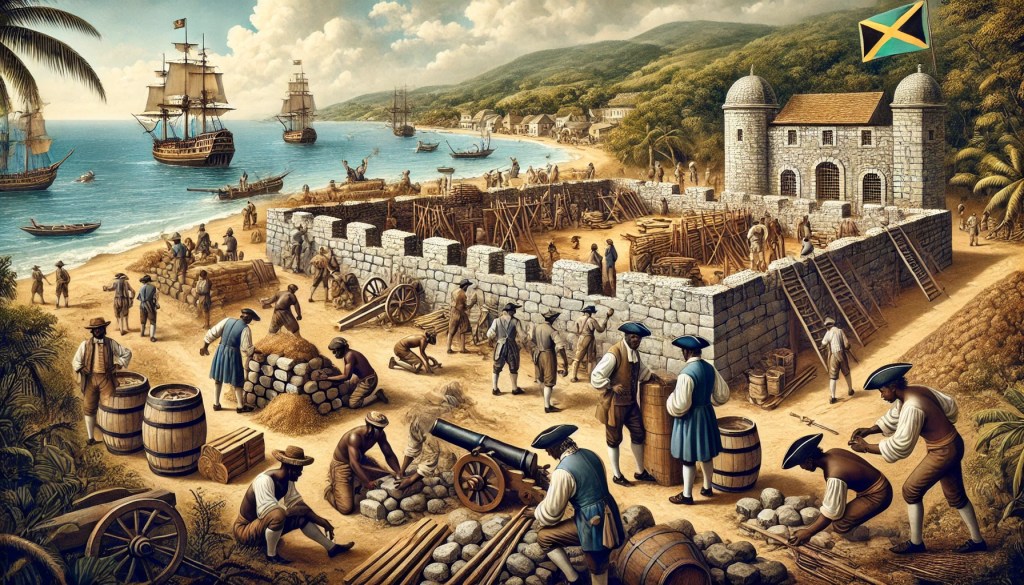
Since the English captured Jamaica from the Spanish in 1655, the need for fortified structures became urgent to defend against frequent threats of invasion. This prompted the construction of numerous forts along Jamaica’s coastline, with a focus on protecting Port Royal, then the island’s main naval and commercial hub.
Funding for these fortifications was allocated by the House of Assembly in Spanish Town, St. Catherine. In the relatively peaceful 18th century, around £1,250 was typically set aside for forts annually out of a £7,000 budget. However, during times of heightened threat, such as in 1746 and toward the end of the century when the risk of French invasion increased, the Assembly approved significantly larger amounts—£9,000 and even £20,000—to bolster defenses.
A special committee within the House of Assembly managed the funds for fort construction, awarding contracts to local builders who undertook the work with durable materials, primarily stone from Jamaican quarries, supplemented occasionally with stone imported from Bath, England. Skilled labor was largely provided by enslaved individuals, with up to 500 people working on a single project at times, drawn from nearby estates or prisons.
Strategically, forts were built on elevated ground where possible, maximizing their defensive advantage over the coastline. Some forts, however, were constructed on flatter areas near the shore, tailored to accommodate various numbers of guns depending on the defense needs of the area. During the period of intense fortification, Jamaica boasted around 20 forts, each varying in capacity and defensive strength, creating a network of protective outposts that marked the island’s landscape and served as deterrents to would-be invaders.