
 by
by 
At the Organization of American States in Washington, JamaicaJamaica, with its vibrant culture and stunning landscapes, has a unique position in the global real estate market. The i... More made a familiar call: move beyond remembrance and toward reparatory action.
It was not a new argument.
But that is exactly why it matters.
Subscribe to Jamaica HomesJamaica Homes is a premier real estate company offering a comprehensive platform for buying, selling, and renting proper... More
Jamaica Homes is a reader-supported publication.
Jamaica Homes brings together peopleThe people of Jamaica embody a spirit that is at once richly diverse and unbreakably unified, as captured by the nationa... More, propertyProperty encompasses a wide range of tangible assets that individuals or entities can own, utilize, or invest in, includ... More, and place News, insight, and real opportunities—straight to your inbox.
Because when something is repeated across generations, it stops being a request — and starts becoming evidence.
Evidence that something unfinished still remains.
Jamaica’s story is often told as history.
SlaverySlavery in Jamaica, which began in the early 17th century following the island's colonization by the British, was a brut... More. Emancipation. Independence.
A sequence of events, neatly arranged, safely placed in the past.
But the reality is less tidy.
Slavery in Jamaica was not just a system of labour. It was a system of structure — shaping landIn real estate, land is a foundational element that significantly impacts the value and potential of a property. It enco... More, economy, identity, and power. By the early 1800s, hundreds of thousands of enslaved people lived under conditions designed to extract, control, and suppress.
When emancipation came in 1838, it ended the legalityLegality in contract law refers to the requirement that the terms and purpose of an agreement must comply with establish... More of slavery.
But it did not dismantle the structure that slavery had built.
“Freedom came,” says Dean JonesDean Jones is a chartered builder, project manager, licensed real estate professional and the founder of Jamaica Homes, ... More, founder of Jamaica Homes, “but repair did not. And when repair doesn’t happen, the system doesn’t disappear — it continues, just in a different form.”
That continuation is not always obvious.
It does not announce itself loudly.
Instead, it shows up quietly — in patterns.
Patterns in land ownershipLand ownership is the legal right to possess, use, and control a piece of land, often including any structures or resour... More.
Patterns in opportunity.
Patterns in outcomes.
And perhaps most quietly, patterns in health.
Across Jamaica and the wider diasporaIn the context of Jamaica, real estate, and the broader global sphere, diaspora refers to the community of Jamaicans liv... More, conditions like high blood pressure and diabetes appear more frequently than many expect. These are often explained as lifestyle issues — diet, exercise, personal choice.
But that explanation only tells part of the story.
Because it ignores environment.
“This isn’t about saying people don’t have responsibility,” Jones says. “It’s about recognising that people make choices inside conditions they didn’t create.”
Those conditions — shaped over time by inequality, stress, and limited access — affect the body itself. Not in a dramatic, visible way, but slowly, steadily, over generations.
History does not sit outside the body.
In many cases, it settles within it.
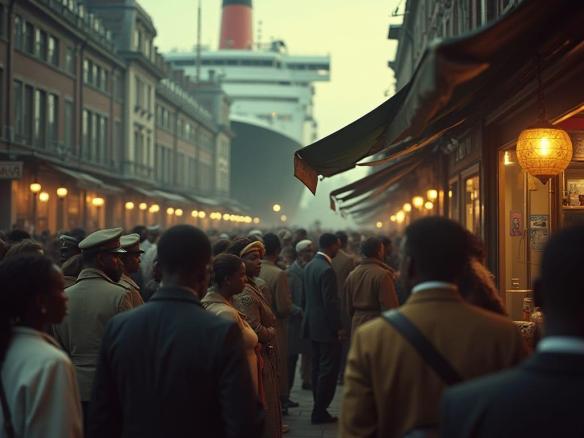
Then came migration.
The Windrush generationThe Windrush generation, encompassing Caribbean immigrants arriving in the United Kingdom between 1948 and 1971, has lef... More marked another chapter — one of movement, hope, and contribution. JamaicansJamaicans are a resilient and vibrant people with a deep-rooted history defined by courage, resistance, and cultural ric... More travelled to help rebuild post-war Britain.
But they also encountered barriers.
Housing restrictions. Employment limits. Social exclusion.
Different place. Different system.
Familiar pattern.
“I come from that story,” Jones says. “You move forward, you contribute, you build — and still find yourself navigating structures that weren’t built with you in mind. That pressure doesn’t disappear. It accumulates.”
This is where the conversation shifts.
Because reparatory justice is often misunderstood as a backward-looking idea — a debate about history alone.
It is not.
At its core, it asks a simple question:
If the effects of a system are still visible, does responsibility still exist?
Globally, reparations are defined not just as financial compensationCompensation refers to the payment or reward given in exchange for services or work performed. In the context of real es... More, but as a broader set of actions — including developmentIn Jamaica, the term "development" can refer to various contexts, each with its unique focus and implications. Real esta... More, education, public health, and institutional reform.
In other words, repair is not just about what was taken.
It is about what still needs to be built.
This is not a story of division.
It is a story of continuity.
Because every society inherits something from its past — structures, advantages, imbalances. The question is not whether those inheritances exist.
The question is whether we acknowledge them.
And more importantly, whether we act on them.
“Reparations isn’t about blame,” Jones says. “It’s about responsibility. If something was broken — and we can still see the cracks — then fixing it is not about the past. It’s about the future.”
Jamaica may be small.
But its voice carries weight.
Not because of size, but because of clarity.
It has lived the full arc — from one of the most intense slave societies in the CaribbeanThe Caribbean is a vast region made up of over 700 islands, islets, reefs, and cays. Some of the most well-known islands... More, through migration, through modern global integration. It understands, in a very real way, how history moves.
Not as memory alone.
But as structure.
The call made this month in Washington was not dramatic.
It did not need to be.
Because its power lies in its persistence.
A steady reminder that the story is not finished.
That emancipation was a beginning — not an end.
And that freedom, without repair, remains incomplete.
“There comes a point,” Jones says, “when history stops being something you look back on and becomes something you’re still living through.”
That point may already be here.
The question is no longer whether the case has been made.
It has.
The question is whether we are prepared to answer it.
Or whether, years from now, the same call willIn Jamaica, a will is a legal document created by an individual to specify how their assets, including their belongings ... More be made again —
still waiting to be heard.
Discover more from Jamaica Homes
Subscribe to get the latest posts sent to your email.
Discover more from Jamaica Homes
Subscribe to get the latest posts sent to your email.


Join The Discussion