


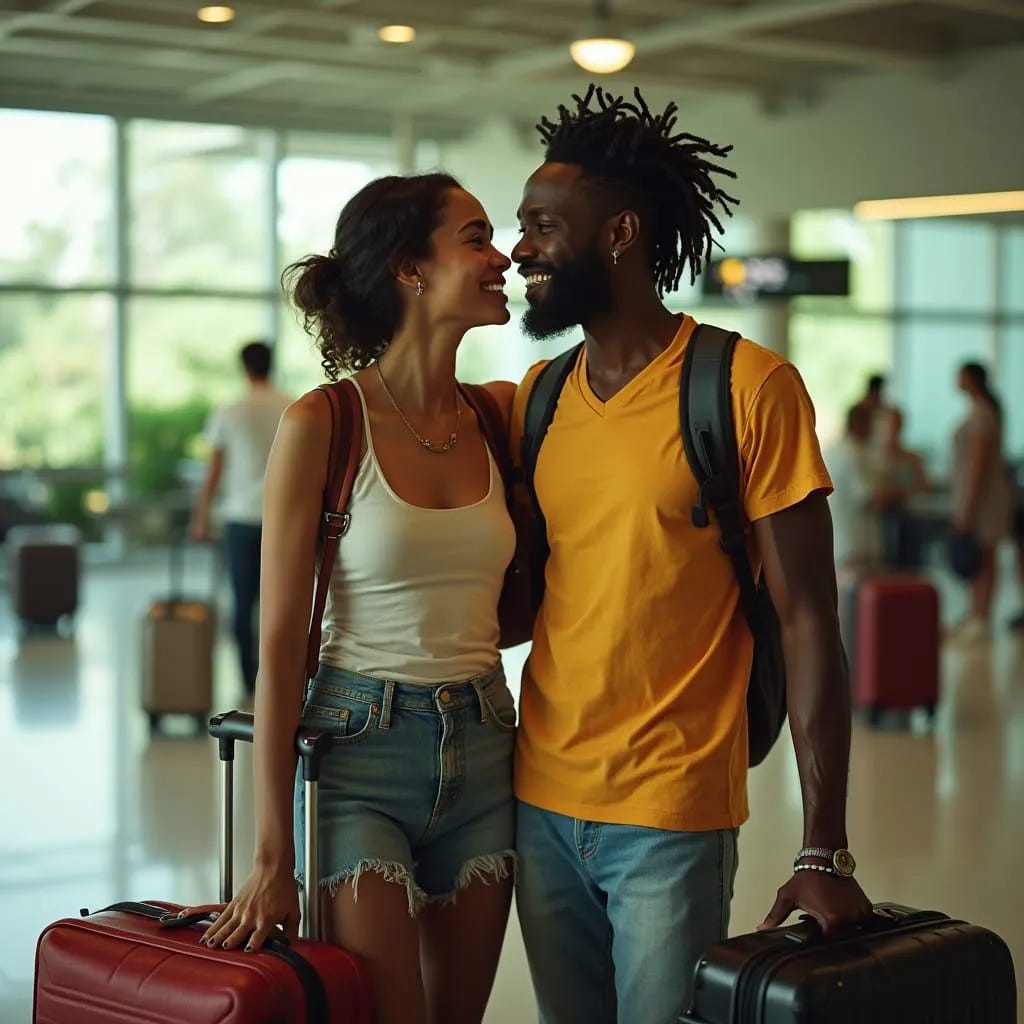
There are moments when large systems shift quietly, almost politely, without headlines or panic. No collapse, no crash — just a subtle rebalancing. The decline in Caribbean travel to the United States in 2025 feels like one of those moments.
People did not stop travelling. Money did not disappear. Instead, something more interesting happened: movement slowed, and intention sharpened.
For Jamaica, the question is not what the United States lost in visitor numbers. The more revealing question is what Jamaica may now keep — attention, capital, time, and ultimately commitment.
This is not an argument built on optimism or conjecture. It is rooted in patterns that repeat themselves whenever friction enters a system that was once fluid. When crossing borders becomes more expensive, more uncertain, or more emotionally fraught, people do not abandon their desire for quality of life. They simply look closer to home.
A pause in movement often leads to permanence
For decades, outward travel — particularly to the United States — has been woven into the rhythm of Caribbean life. Short breaks, shopping trips, family visits, medical appointments, moments of escape. These journeys were not luxuries in the abstract; they were extensions of how people managed work, wellbeing, and aspiration.
When barriers rise — higher visa fees, longer processing times, sudden pauses, heightened scrutiny — those rhythms change. Trips are postponed. Frequency drops. And gradually, a question surfaces: If I’m not going there as often, what do I do instead?
History suggests that spending rarely evaporates. It reorients.
Money once allocated to flights, hotels, retail and short-term experiences begins to search for something steadier. Something that lasts. In small, open economies like Jamaica’s, that search often leads back to land and property.
Not immediately. Not dramatically. But deliberately.
Jamaica’s real estate story has never been purely foreign
It is important to avoid lazy narratives here. Jamaica’s property market has never been driven solely by tourism or foreign buyers. It has always been layered — shaped by local households, returning residents, diaspora capital, small investors, and families thinking across generations.
What makes the current moment distinctive is not who participates in the market, but why decisions are being reconsidered.
When international mobility becomes less predictable, ownership becomes more meaningful. A house is no longer just shelter or yield. It becomes an anchor — emotional as much as financial.
As Dean Chance, founder of Jamaica Arms, puts it:
“Property in Jamaica has never been about quick wins. It’s about placing something solid under your life. When the world feels harder to navigate, people instinctively look for ground they can stand on — and for Jamaicans, that ground is home.”
Retained capital and the quiet logic of staying closer
The reduction in outward travel does not automatically translate into a boom for the local economy. That would be simplistic. Inflation remains real. Household budgets are under pressure. Construction costs have risen, and the after-effects of recent hurricanes are visible in food, utilities, insurance and housing expenses.
But inflation does not freeze behaviour. It forces prioritisation.
Instead of multiple overseas trips, households reassess. Instead of spending episodically, they think structurally. Renovation replaces retail tourism. Location replaces novelty. Longevity begins to matter more than immediacy.
This is where real estate quietly re-enters the conversation.
Not as speculation, but as strategy.
Property as a response to uncertainty
One of the least discussed effects of global friction is psychological. When borders feel less welcoming, people respond by improving what they already control. Property offers that control.
A better home. A second unit. A piece of land held patiently. These decisions are rarely loud, but they are deeply rational.
Dean Jones reflects on this shift in tone:
“When travel slows, people don’t stop dreaming — they just dream differently. Real estate becomes a way of saying, ‘I’m investing in where I belong.’ That’s not fear. That’s maturity.”
This mindset aligns closely with Jamaica’s cultural relationship to land. Ownership here has always carried meaning beyond price per square foot. It speaks to legacy, security, and continuity.
Economic signals still shape confidence
Alongside inflationary pressure, Jamaica is also sending forward-looking signals. New economic zones, infrastructure projects and construction-led employment matter because they influence confidence — and confidence precedes commitment.
People are more willing to buy, build or invest when they believe the country is moving somewhere, even if the journey is uneven.
Real estate markets do not respond to perfection. They respond to direction.
A Caribbean shift, a Jamaican lens
The wider Caribbean is experiencing similar dynamics, but Jamaica’s position is distinct. Market depth, diaspora ties and an enduring emotional pull toward home mean that retained capital has somewhere to go.
This is not about comparison between islands. It is about recognising a shared regional recalibration and understanding how Jamaica’s property market absorbs pressure differently — often more resiliently.
Not retreat, but restraint
What is emerging is not a runaway market, nor a stalled one. It is a more thoughtful environment.
Buyers ask harder questions. Developers must justify value. Long-term use matters more than short-term excitement. This is healthy.
Periods of restraint tend to expose fundamentals. Well-located, legally sound, purpose-built developments endure. Others fade.
Where this leaves us
The decline in US-bound Caribbean travel is not the story. It is the context.
The real story is what happens when movement slows and attention turns inward. When capital looks for permanence rather than passage. When people decide not just where to visit, but where to belong.
If travel pauses, money does not disappear. It waits. It watches. And eventually, it settles.
The task for Jamaica’s real estate sector is not to chase that capital, but to be worthy of it.