
 by
by 
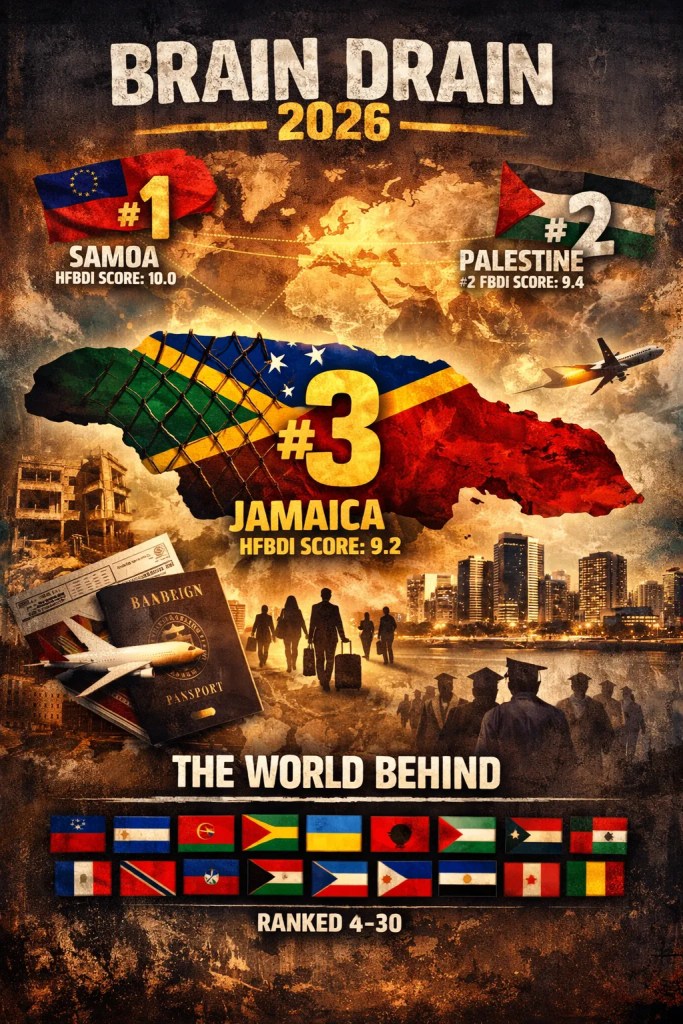
Updated: The Human Flight and Brain Drain Index (HFBDI) does not flatter small nations. Scored from 0 to 10, it measures the economic impact of human capitalCapital refers to the financial resources, whether in the form of equity, debt, or other assets, that individuals or bus... More flight—what we casually call brain drain. In the 2026 ranking, countries like Samoa (10.0), Palestine (9.4), and JamaicaJamaica, with its vibrant culture and stunning landscapes, has a unique position in the global real estate market. The i... More (9.2) still sit at the sharp end. This is familiar territory. Jamaica has been number two, now number three. A drop, yes—but not a victory. Third place in a race you never wanted to run is still too close to the front.
What makes Jamaica’s position so striking is not just the score, but the comparison set. At the very top are nations ravaged by war, sanctions, or extreme poverty. Jamaica does not belong in that category. And yet, year after year, it bleeds talent at a rate comparable to countries in active crisis. That contradiction is the heart of the problem—and the key to the solution.
What Brain Drain Really Looks Like in Jamaica
Brain drain is often framed as an abstract economic concept. In Jamaica, it is personal. It starts early—at school. Our education system, by designDesign is the art and science of creating plans and specifications for the construction of objects, structures, and syst... More and by culture, prepares children to leave. Scholarships to the United States or the United Kingdom are celebrated as the highest markers of success. Staying is rarely positioned as ambition; leaving is.
This is not accidental. Jamaica’s domestic economy offers limited high-paying career paths outside a narrow band: tourismTourism in Jamaica refers to the industry focused on attracting visitors to the island, who come to experience its natur... More, government, law, medicine, banking, and a handful of entrepreneurial lanes. If you own the business, you can thrive. If you work in it—especially in administration, retail, or mid-level professional roles—the ceiling is low and arrives quickly.
So the message to the young and talented is clear:
Go. Earn. Return—if you must. Or invest from afar.
And many do exactly that.
“For too many JamaicansJamaicans are a resilient and vibrant people with a deep-rooted history defined by courage, resistance, and cultural ric... More, the dream of owning landIn real estate, land is a foundational element that significantly impacts the value and potential of a property. It enco... More and a home is now realised only after leaving the island. That should trouble us. Real estateReal estate refers to property consisting of land and the structures on it, such as buildings and homes. It also include... More should be a foundationThe foundation of a building is its underlying support system, designed to distribute the load of the structure and prov... for national stability, not a reward for absence. If Jamaicans must leave to afford Jamaica, then we are exporting peopleThe people of Jamaica embody a spirit that is at once richly diverse and unbreakably unified, as captured by the nationa... More while importing inequality.”
— Dean JonesDean Jones is a chartered builder, project manager, licensed real estate professional and the founder of Jamaica Homes, ... More, Founder, Jamaica HomesJamaica Homes is a premier real estate company offering a comprehensive platform for buying, selling, and renting proper... More and Realtor AssociateA Realtor Associate in Jamaica is a registered real estate salesman licensed under the Real Estate (Dealers and Develope... More
The Jamaican Dream—Outsourced
The JamaicanThe term "Jamaican" encompasses the citizens of Jamaica and their descendants in the Jamaican diaspora, representing a d... More dream has quietly shifted. Once, it was land, family, and communityIn Jamaica, "community" refers to more than just a geographic area; it embodies a collective identity rooted in shared e... More built here. Today, it is increasingly realised abroad first, then partially repatriated through real estateIn Jamaican real estate, an estate refers to the total collection of assets and property owned by an individual, especia... More investment"Investment" in the realm of real estate refers to the allocation of money or resources into property with the expectati... More.
Homes priced at US$300,000–$500,000 dominate aspiration. For the average Jamaican professional, that price tag is unattainable without foreign incomeIncome refers to the money or value that individuals or businesses receive, typically from various sources such as salar... More. The result? A paradox:
- Migration enables ownership
- Ownership inflates prices
- Inflated prices push more people to migrate
This cycle benefits returnees and diasporaIn the context of Jamaica, real estate, and the broader global sphere, diaspora refers to the community of Jamaicans liv... More investors—but it sidelines those who never left. Real estate becomes both the reward for leaving and the barrier to staying.
Jamaica as a Global Brand—And Who Profits From It
Here is an uncomfortable truth: Jamaica is one of the most powerful brands on Earth.
Music. Culture. Sport. Identity. Energy.
Few countries punch so far above their weight in global recognition.
Yet brand power does not equal domestic prosperity.
Multinational companies profit immensely from Jamaican cultureJamaican culture reflects centuries of diverse influences, shaped by colonization, migration, and a blend of African, Eu... More, imagery, and labour—often extracting far more value than they reinvest. Yes, tax revenue remains. But ownership, intellectual propertyProperty encompasses a wide range of tangible assets that individuals or entities can own, utilize, or invest in, includ... More, and long-term capital frequently do not. Jamaica’s brand has been, in part, sold outward, monetised elsewhere, and repackaged back to us at a premium.
This is not unique to Jamaica—but it is especially acute here.
Is Brain Drain Always Bad? Lessons From Elsewhere
The global evidence is more nuanced than the fear narrative suggests.
- The Philippines saw nurses migrate en masse to North America. The result? Higher living standards abroad and increased human capital at home through remittances, skills transfer, and eventual return.
- India watched IT professionals leave for Silicon Valley, then return—fueling a domestic tech boom that transformed cities like Bangalore.
- China executed something even bolder: a multi-decade national vision. Five-year plans stacked into ten, then fifty. Talent left, learned, returned—or partnered from abroad. The state never lost sight of the long game.
Brain drain becomes destructive only when there is no return pathway, no reintegration strategy, and no vision.
“Jamaica does not suffer from a lack of talent; it suffers from a lack of long-term vision. When a country educates its children to leave but does not build enough reasons for them to stay, the loss is not accidental—it is designed. Brain drain is not just migration; it is the quiet cost of thinking only in five-year political cycles instead of fifty-year national ones.”
— Dean Jones, Founder, Jamaica Homes
Jamaica’s Missing Piece: Vision With Time Horizons
“Where there is no vision, the people perish.”
Proverbs 29:18 (KJV)
Jamaica does not lack talent. It lacks a clearly articulated, nationally shared vision across time.
Not slogans.
Not manifestos.
But aligned, measurable plans:
- 5-year plans: housing affordability, professional wage floors, SME access to capital
- 10-year plans: sector diversification beyond tourism, diaspora co-investment vehicles
- 50-year plans: land useLand use in the context of real estate in Jamaica refers to how different parcels of land are utilized and designated fo... More, climate resilience, intergenerational wealth
- 100-year plans: populationPopulation refers to the total number of people inhabiting a defined geographic area and encompasses their demographic, ... More stability, ownership of brand, national legacyLegacy, in the context of Jamaica, real estate, and the broader world, represents the enduring impact of past actions, a... More
China did not reverse its trajectory by accident. It did so by thinking longer than election cycles.
What Can Actually Change the Equation?
1. Make Staying Economically Rational
People are not disloyal for leaving—they are rational. Jamaica must:
- Support high-value industries (tech, logistics, creative IP, climate services)
- Create professional wage pathways that allow dignity without foreign income
- De-risk entrepreneurship for locals, not just foreign investorsIn Jamaica, foreign investors are individuals or entities from other countries who invest money into Jamaican businesses... More
2. Treat the Diaspora as Partners, Not Just Senders
Remittances are not strategy.
Co-ownership is.
Structured diaspora bonds, land trusts, and developmentIn Jamaica, the term "development" can refer to various contexts, each with its unique focus and implications. Real esta... More partnerships can turn outward migration into shared national growth, not silent extraction.
3. Reform Real Estate as Nation-Building, Not Speculation
Real estate is central—but unmanaged, it widens inequality.
- National planningNational planning in Jamaica represents a comprehensive strategy for the country's growth and development, aiming to bal... More goals must guide development
- Affordable housingAffordable housing in Jamaica is an increasingly pressing issue, with rising land and construction costs making home own... More must be protected from pure market distortion
- Land should be a tool for stability, not just profit
4. Own the Jamaican Brand—Legally and Economically
From music to food to sport, Jamaica must:
- Retain IP value
- Negotiate fairer global partnerships
- Ensure cultural exports generate domestic capital, not just applause
Is It Too Late?
No.
But it is close.
The warning signs are clear: population stagnation, professional shortages, rising housing costs, and a generational expectation that success equals exit.
Yet Jamaica still holds something rare: global desire. People want to come. They want to invest. They want to belong. That desire must be channelled with intention—or it willIn Jamaica, a will is a legal document created by an individual to specify how their assets, including their belongings ... More continue to bypass the very people who give the island its soul.
The End Result of Brain Drain—If Jamaica Chooses Wisely
Brain drain does not have to end in loss. It can end in circulation.
Talent can leave—and return.
Capital can flow out—and back in.
Dreams can be formed abroad—and realised at home.
But only if Jamaica chooses principles over drift, vision over short-termism, and people over pure profit.
Jamaica can thrive.
Not because it is lucky.
But because it decides—collectively—to think beyond today.
And to finally answer the question every young Jamaican quietly asks:
“Can I build a good life here—and stay?”
If that answer becomes yes, the index will follow.
DisclaimerA disclaimer is a statement that serves to limit or exclude liability, usually found in legal documents, websites, produ... More: The brain drain rankings and index values referenced in this article are sourced from World Population Review, which compiles the Human Flight and Brain Drain Index (HFBDI) for countries worldwide. This index measures the economic impact of human capital flight on a scaleScale is a fundamental concept in cartography that translates the vastness of the real world into manageable proportions... More from 0 (lowest) to 10 (highest), with higher scores indicating greater levels of skilled emigration. The most recent available data spans from 2007 to 2023 and was accessed at the time of publication; future updates may adjust scores or rankings. This presentation of the data is provided for informational and contextual purposes only and should not be interpreted as predictive or definitive of future trends.


Join The Discussion