In JamaicaJamaica, with its vibrant culture and stunning landscapes, has a unique position in the global real estate market. The i... More, a home is never just a structure. It is shelter, legacyLegacy, in the context of Jamaica, real estate, and the broader world, represents the enduring impact of past actions, a... More, resilience, and—especially after Hurricane Melissa—a symbol of survival and renewal. As communities across the island continue to repair, rebuild, and reimagine their spaces, conversations about home improvement must be handled with care, realism, and respect for context. This is not the United States. Our climate, constructionConstruction is the dynamic process of designing and erecting buildings and infrastructure, crucial for shaping modern l... More methods, buyerA buyer is an individual or entity that acquires goods, services, or properties through a transaction, motivated by a ne... More expectations, financing realities, and cultural priorities are different. What adds value here must be judged through a JamaicanThe term "Jamaican" encompasses the citizens of Jamaica and their descendants in the Jamaican diaspora, representing a d... More lens.
This piece is not about pushing upgrades for the sake of resaleResale refers to the act of selling items or properties that have already been owned or used by someone else. This conce... More alone. It is about making wise, durable, and context-sensitive decisions—whether you plan to sell, rentRent, at its core, is a financial arrangement where a tenant pays a landlord for the use of a property over a specified ... More, pass on propertyProperty encompasses a wide range of tangible assets that individuals or entities can own, utilize, or invest in, includ... More to family, or simply live more comfortably and safely in the years ahead.
As Dean JonesDean Jones is a chartered builder, project manager, licensed real estate professional and the founder of Jamaica Homes, ... More, founder of Jamaica HomesJamaica Homes is a premier real estate company offering a comprehensive platform for buying, selling, and renting proper... More, often reminds clients:
“In Jamaica, value isn’t only what a buyer willIn Jamaica, a will is a legal document created by an individual to specify how their assets, including their belongings ... More pay tomorrow. It’s what allows a family to live securely today and still have options in the future.”
Reframing “Return on Investment” for Jamaica
In the U.S., return on investment (ROI)In Jamaican real estate, Return on Investment (ROI) measures the profitability of a property investment by comparing the... More is often calculated narrowly: spend XAn "X" is a symbolic mark made by individuals who either cannot write or are physically unable to write, used to indicat... More, get Y back at resale. In Jamaica, ROI must be broader. It includes:
Storm resilience
Reduced maintenance costs
Lower insurance riskA risk is the possibility of an adverse outcome or loss arising from uncertainty or potential hazards. It represents the... More
Rental flexibility
Multi-generational use
Buyer confidence in construction quality
After Hurricane MelissaHurricane Melissa (noun) Definition: Hurricane Melissa is a historic and catastrophic tropical cyclone that struck... More, these considerations are no longer theoretical. They are lived realities.
A home that survives, functions, and insures well already delivers value—long before a sale is even contemplated.
1. Structural Strength: The Quiet Champion of Value
Jamaican properties—particularly older ones—vary widely in construction quality. Buyers and valuers pay close attention to structural integrity, especially in hurricane-prone zones.
ProjectsA project or projects, within the Jamaican context, refers to a planned endeavor undertaken to achieve specific goals or... More that matter here include:
Roof reinforcement and proper hurricane strapping
Replacing aging timber elements with treated wood or steel
Concrete repairs and crack remediation
Improved drainage around foundations
These upgrades rarely photograph well for listings, but they speak volumes during inspections and valuations.
“The strongest homes don’t shout. They stand quietly when the wind does its worst,” says Dean Jones.
2. Roofing: Not Glamorous, But Non-Negotiable
In Jamaica, a roof is not a cosmetic feature—it is a frontline defence.
Replacing or upgrading roofing materials to modern hurricane-rated standards can dramatically improve:
Insurance terms
Buyer confidence
Rental viability
Long-term maintenance costs
Galvalume, properly installed concrete tiles, and improved fastening systems consistently outperform cheaper fixes.
This is one of those upgrades where doing it once and doing it right is far cheaper than doing it twice.
3. Windows, Doors, and Openings: Security Meets Climate Reality
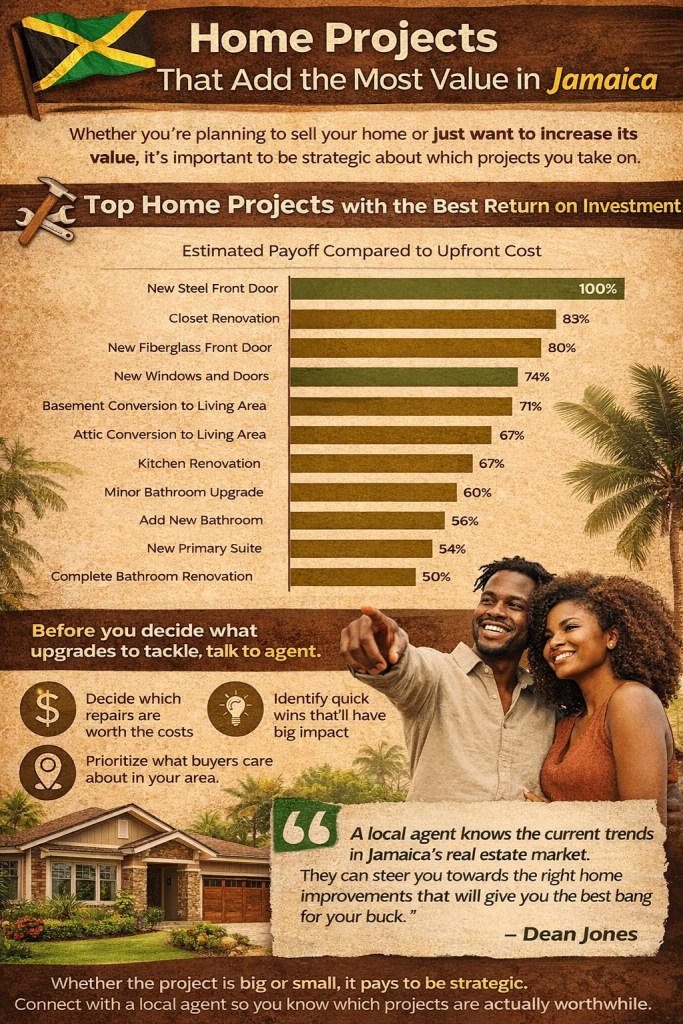
In the U.S., front doors often top ROI lists. In Jamaica, securityIn Jamaican real estate, security refers to assets pledged to back a loan or financial obligation. Typically, the proper... More and storm resistance elevate their importance further.
High-value improvements include:
Steel or reinforced front doors
Properly installed windows with storm shutters or impact resistance
Burglar bars that are thoughtfully designed and code-compliant
These upgrades matter to homeowners, insurers, renters, and buyers alike.
“A Jamaican buyer doesn’t just ask if a home looks good—they ask if it will protect them,” Dean Jones observes.
4. Kitchens: Function Over Flash
American renovation culture often pushes full kitchen overhauls. In Jamaica, the smarter approach is usually strategic upgrading, not complete replacement.
High-impact kitchen improvements include:
Durable countertops suitable for heat and heavy use
Improved ventilation
Practical cabinetry resistant to humidity
Updated plumbing and electrical systems
A modest, well-thought-out kitchen often outperforms an expensive but impractical one. Granite that cracks in heat or imported cabinetry that swells in humidity adds cost without value.
There is a quiet irony here: the most valuable kitchen is often the one that doesn’t try too hard.
5. Bathrooms: Durability Is the New Luxury
Bathrooms matter, but again, context is key.
Value-adding upgrades include:
Water-efficient fixtures
Proper waterproofing
Anti-slip flooring
Reliable water pressure solutions
After storms, plumbing failures can be devastating. Buyers know this. Renters remember this.
“In Jamaica, luxury is not excess—it’s reliability,” says Dean Jones.
6. Energy and Water Resilience: Jamaica’s Real ROI Secret
This is where Jamaican homes diverge sharply from U.S. assumptionsAssumptions are underlying conditions or factors that are accepted as true or certain without concrete proof, which infl... More.
Solar panels, water tanks, and backup systems do not always show up cleanly in traditional valuationValuation involves assessing the worth of a property based on various factors such as its location, condition, size, and... More spreadsheets—but they matter enormously in real life.
Homes with:
Solar water heaters
Rainwater harvesting systems
Water storage tanks
Backup power options
consistently attract stronger interest, especially from overseas buyers, retirees, and long-term renters.
In a country where utility interruptions are not hypothetical, resilience equals value.
7. Yard Space, Drainage, and External Works
After Hurricane Melissa, drainage is no longer a “nice-to-have.” Poor external works can undermine even the best-built houseA house serves as a fundamental structure designed for residential living, providing shelter and a place for individuals... More.
Value-adding external improvements include:
Proper site grading
Functional drains and soakaways
Retaining walls where needed
Secure boundary fencing
A well-managed yardIn Jamaican Patois, the term "yard" carries a special significance beyond its literal meaning of a plot of land. Traditi... More signals responsible ownership—and reassures buyers that floodingFlooding is a significant concern in Jamaica's real estate market, particularly in areas prone to heavy rainfall and hur... More risks have been considered.
8. Conversions and Additions: Proceed with Care
BasementA basement is a space located below the main floor of a building, often used for storage, living areas, or utility purpo... More and attic conversions are common in U.S. ROI lists. In Jamaica, they require caution.
Before converting:
Check planningPlanning in Jamaica involves managing land, resources, and infrastructure to support economic growth, social development... More approvals
Assess structural capacity
Consider ventilation and heat management
Poorly executed additions often reduce value rather than add it—especially when they compromise airflow or violate planning standards.
Or, to put it another way: adding space that no one enjoys using is like buying extra luggage for a trip you never take.
A Thoughtful Pause for a Country Rebuilding
It is important to say this clearly: not every homeowner is in a position to upgrade right now. Many are still repairing roofs, replacing furniture, and restoring basic stability after Hurricane Melissa.
This conversation is not about pressure. It is about prioritisation when the time is right.
“Rebuilding is not a race. It’s a series of careful choices made with tomorrow in mind,” reflects Dean Jones.
Sometimes the best investment"Investment" in the realm of real estate refers to the allocation of money or resources into property with the expectati... More is simply restoring safety, dignity, and peace of mind.
The Role of Local Expertise
What works in Florida, Texas, or California does not automatically work in ClarendonClarendon is a parish situated in central Jamaica, known for its diverse landscape that includes fertile plains and roll... More, St. CatherineSt. Catherine, established in 1664, is one of Jamaica’s seven oldest parishes. Spanning 459.7 square miles, it became ... More, or PortlandPortland is a parish located on Jamaica's northeastern coast, renowned for its lush rainforests, stunning waterfalls, an... More.
Local agents understand:
Parish-level buyer preferences
Insurance realities
Construction norms
What valuers actually reward
This is why blanket online advice must be filtered carefully.
“Real estateReal estate refers to property consisting of land and the structures on it, such as buildings and homes. It also include... More advice without local context is just expensive guesswork,” says Dean Jones.
Building Value the Jamaican Way
In Jamaica, adding value is not about chasing trends—it is about respecting environment, culture, and lived experience.
The homes that hold their value best are not always the most expensive or the most Instagram-ready. They are the ones that:
Weather storms
Function reliably
Adapt to family needs
Respect the landIn real estate, land is a foundational element that significantly impacts the value and potential of a property. It enco... More they sit on
As the island rebuilds, there is an opportunity—not just to restore what was lost, but to build smarter, stronger, and more sustainably than before.
And that, in itself, is a return on investmentIn Jamaica, Return on Investment (ROI) is a financial metric used to evaluate the profitability of an investment, such a... More no spreadsheet can fully capture.
Support Jamaica Homes
Clear, independent information helps peopleThe people of Jamaica embody a spirit that is at once richly diverse and unbreakably unified, as captured by the nationa... More make better decisions about buying property, living in Jamaica, and understanding the housing market. We value whatever you can spare, but a monthly contribution makes the biggest impact, helping us continue creating guides, insights, and resources for JamaicansJamaicans are a resilient and vibrant people with a deep-rooted history defined by courage, resistance, and cultural ric... More and the diasporaIn the context of Jamaica, real estate, and the broader global sphere, diaspora refers to the community of Jamaicans liv... More. Thank you.
Jamaica Homes is a premier digital real estate platform and marketplace designed to help sellers, landlords, and developers list their properties with ease—while connecting them to serious buyers, renters, and investors across Jamaica and overseas. Founded by Dean Jones Licensed Realtor® Associate, Jamaica Homes operates as an independent platform that ensures every listing is verified and professionally handled. Whether you’re selling, renting, or marketing new developments, we provide powerful exposure through our website and social media network. More than just a listings hub, Jamaica Homes is your trusted gateway to reaching the right audience—powered by the vibrant spirit of Jamaica.

 by
by 



Join The Discussion