

Container Homes, Standards, and the Cost of Getting It Wrong: A Measured Look at the Debate

Editor’s Note (Journal)
This article forms part of the Jamaica Homes Journal, where we examine housing, land, and development through a considered, long-form lens. Rather than reporting news, the Journal creates space for professional reflection, critique, and context — especially on issues that sit at the intersection of construction, planning, climate resilience, and real estate in Jamaica.
The piece below responds to a recent public commentary by our founder, not to restate it, but to interrogate the ideas it raises and extend the conversation for readers who care about standards, long-term outcomes, and the future of housing on the island.


Critique Article
Every few years, Jamaica revisits the same uncomfortable question: how do we house people affordably, safely, and at scale — without creating tomorrow’s crisis in the process?
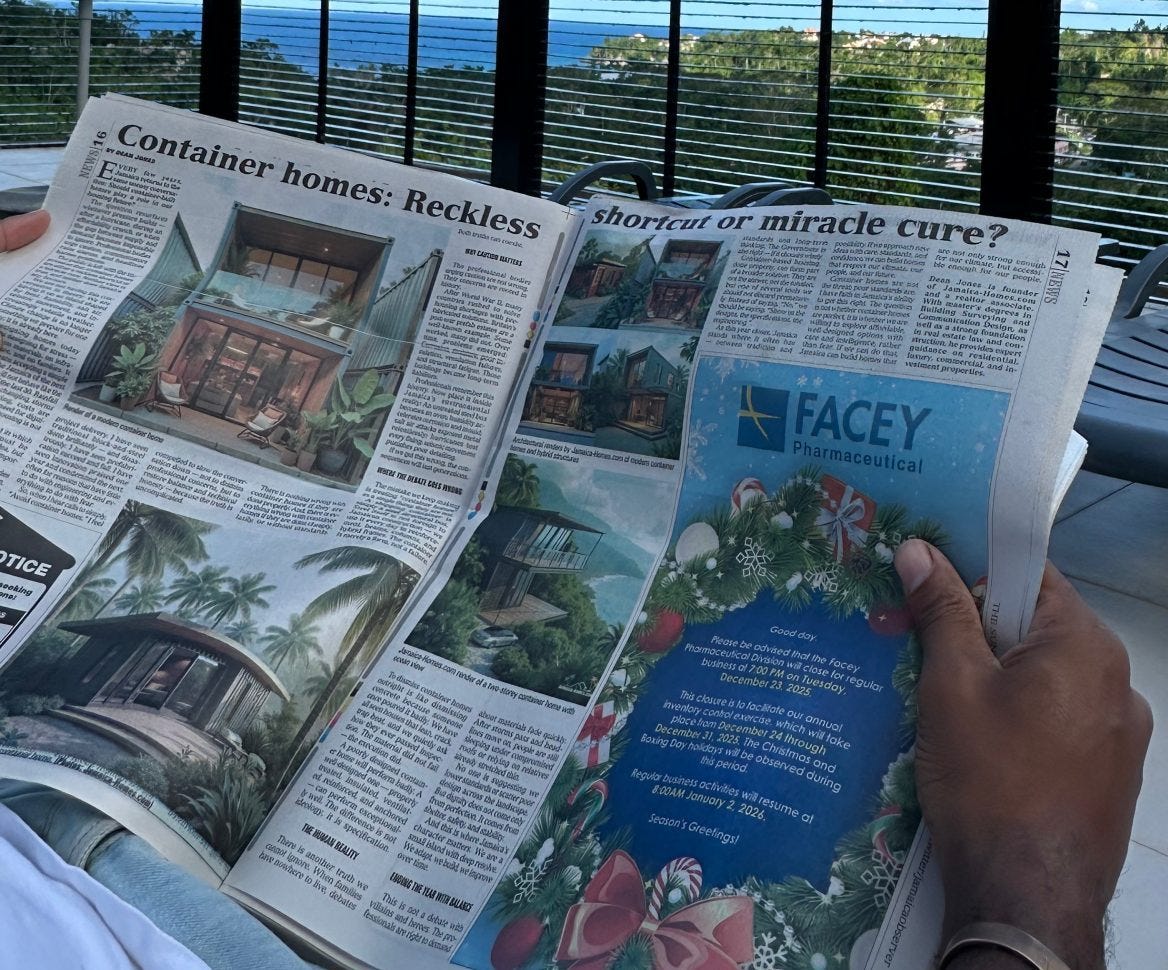
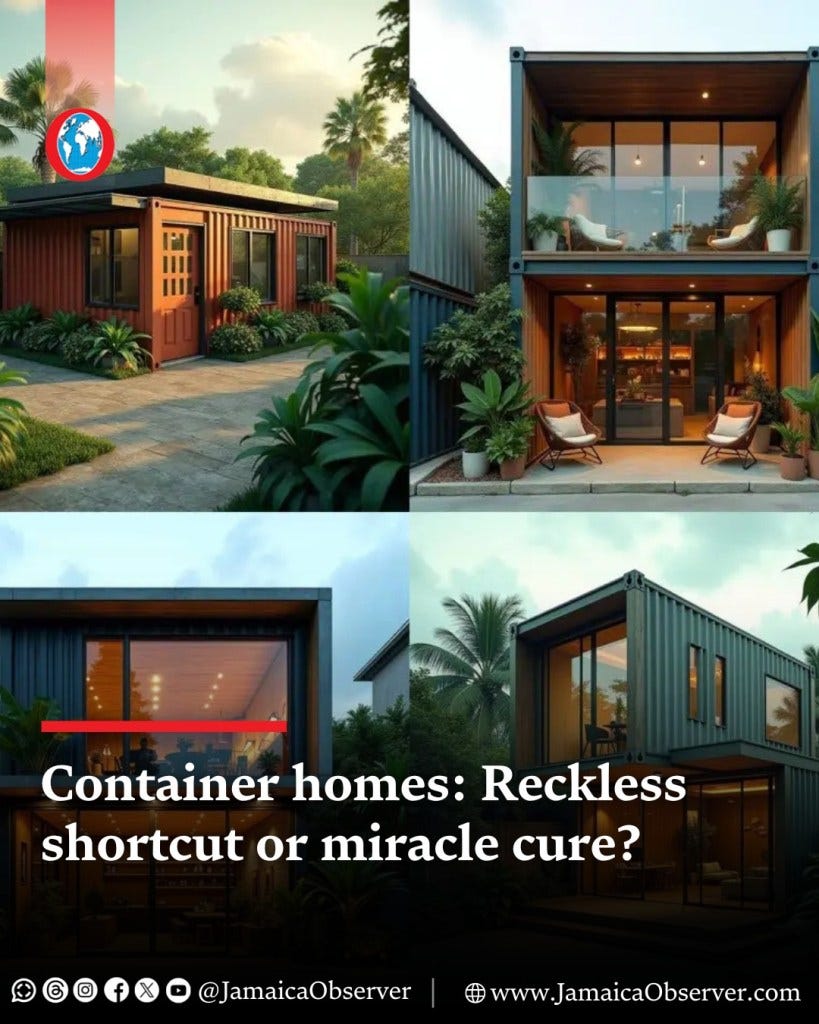
In his recent Jamaica Observer article, “Container homes: Reckless shortcut or miracle cure?”, our founder Dean Jones steps deliberately into that tension. Rather than choosing a side, the article does something more difficult: it asks Jamaica to slow down, think clearly, and separate emotion from engineering.
(You can read the original article here: https://www.jamaicaobserver.com/2025/12/28/container-homes-reckless-shortcut-miracle-cure/)
That framing is the article’s greatest strength — and also the point where further scrutiny is useful.
A needed intervention in a polarised debate
Jones correctly identifies the false binary that dominates public discussion. Container homes are routinely presented as either a dangerous shortcut or a silver bullet for Jamaica’s housing shortage. In reality, neither position survives serious technical examination.
The article is at its most persuasive when it grounds the debate in Jamaica’s environmental reality: heat, humidity, salt air, hurricanes, seismic activity, and climate volatility. These are not abstract risks. They are daily design constraints. Any housing solution — concrete, timber, steel, or hybrid — that ignores them will fail.
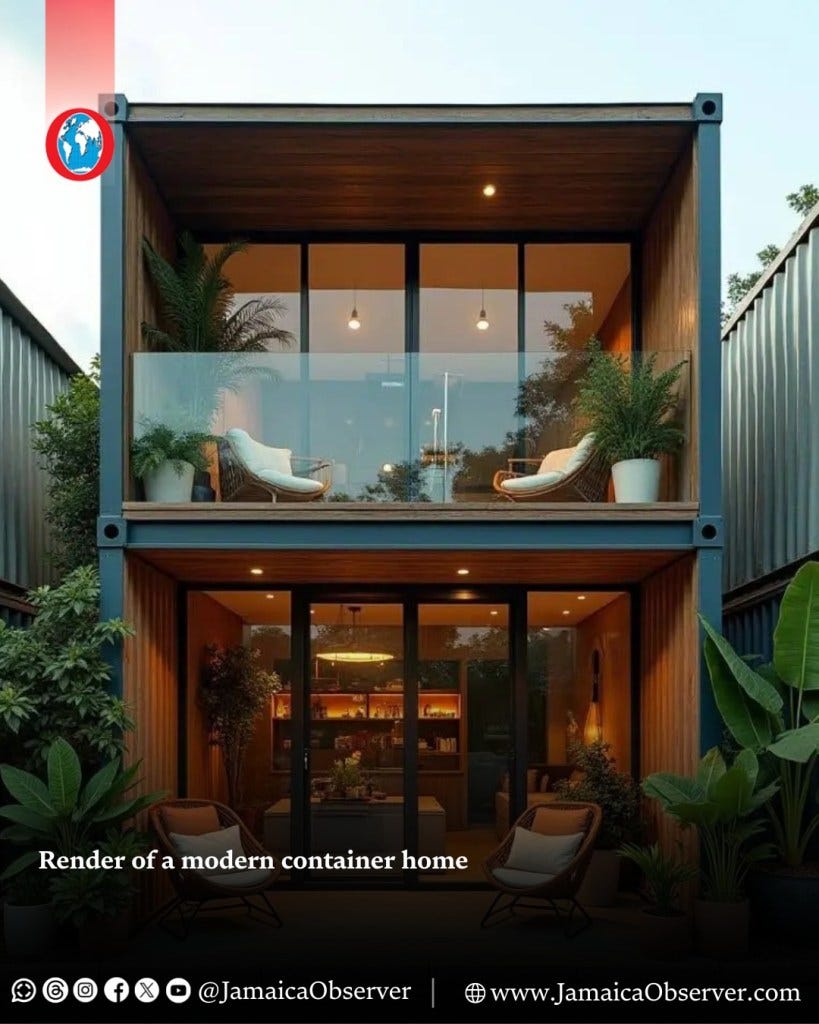
By reframing container homes as a system rather than an idea, the article cuts through a great deal of noise. A shipping container is not housing; it is a structural component. What matters is specification, treatment, insulation, ventilation, anchoring, and long-term maintenance. On this point, the argument is technically sound.
Where the article is strongest
The comparison with post-war prefabrication in Britain is particularly effective. It reminds readers that housing failures rarely come from innovation itself, but from rushed implementation, poor standards, and political expediency. Jamaica has its own version of this history in poorly planned schemes that looked affordable upfront but became expensive to repair, retrofit, or abandon.
Another strength is the refusal to romanticise container homes. Jones is explicit: they are not the solution. They are one possible tool. That restraint matters. Jamaica’s housing crisis is too complex for single-answer thinking, and the article avoids that trap.
The emphasis on dignity is also important. For families living under compromised roofs, material debates are secondary to safety and stability. However, the article is careful not to use urgency as an excuse for lowering standards — a line too often crossed in post-disaster construction.
Where the debate still needs sharpening
Where the article could go further is in addressing governance and enforcement, not just design quality.
Saying “container homes work if done properly” is true — but incomplete. Jamaica’s real challenge is not the absence of good ideas; it is the uneven application of standards. Poor construction outcomes in Jamaica are rarely caused by materials alone. They are caused by weak oversight, inconsistent inspections, informal builds, and cost-cutting under pressure.
A well-designed container home on paper does not guarantee a well-built container home on site. Without clear national guidelines, certification pathways, and inspection protocols specific to container and hybrid structures, the risk is not theoretical. It is systemic.
In other words, the danger is not that Jamaicans will build container homes — it is that they will build bad ones repeatedly, and at scale.
The land question beneath the surface
One subtle but important dimension sits just beneath the article’s surface: land use.
Container homes are often discussed as mobile, temporary, or flexible. But in Jamaica, housing quickly becomes permanent — legally, socially, and emotionally. Once placed on land, a container home is no longer an experiment; it becomes part of the built environment, affecting neighbouring values, infrastructure loads, drainage, and planning norms.
That means the container home debate is also a planning and real estate conversation, not just a construction one. How these structures are zoned, valued, insured, financed, and transferred over time matters just as much as how they are built.
A fair and necessary contribution
Overall, the article succeeds because it does not pretend the answer is simple. It respects professional caution without surrendering to fear. It challenges blanket rejection without promoting shortcuts. And it insists — correctly — that Jamaica is capable of building better than its worst examples.
The real takeaway is not that container homes are good or bad. It is that standards are everything. Poor standards will fail in block-and-steel just as surely as they will fail in steel boxes.
As Jamaica searches for housing solutions that are resilient, affordable, and dignified, this article is a useful reset. It reminds us that materials do not create crises — decisions do.
The next step is ensuring that innovation is matched by regulation, enforcement, and long-term thinking. Without that, any housing “solution” risks becoming the next problem we inherit.