


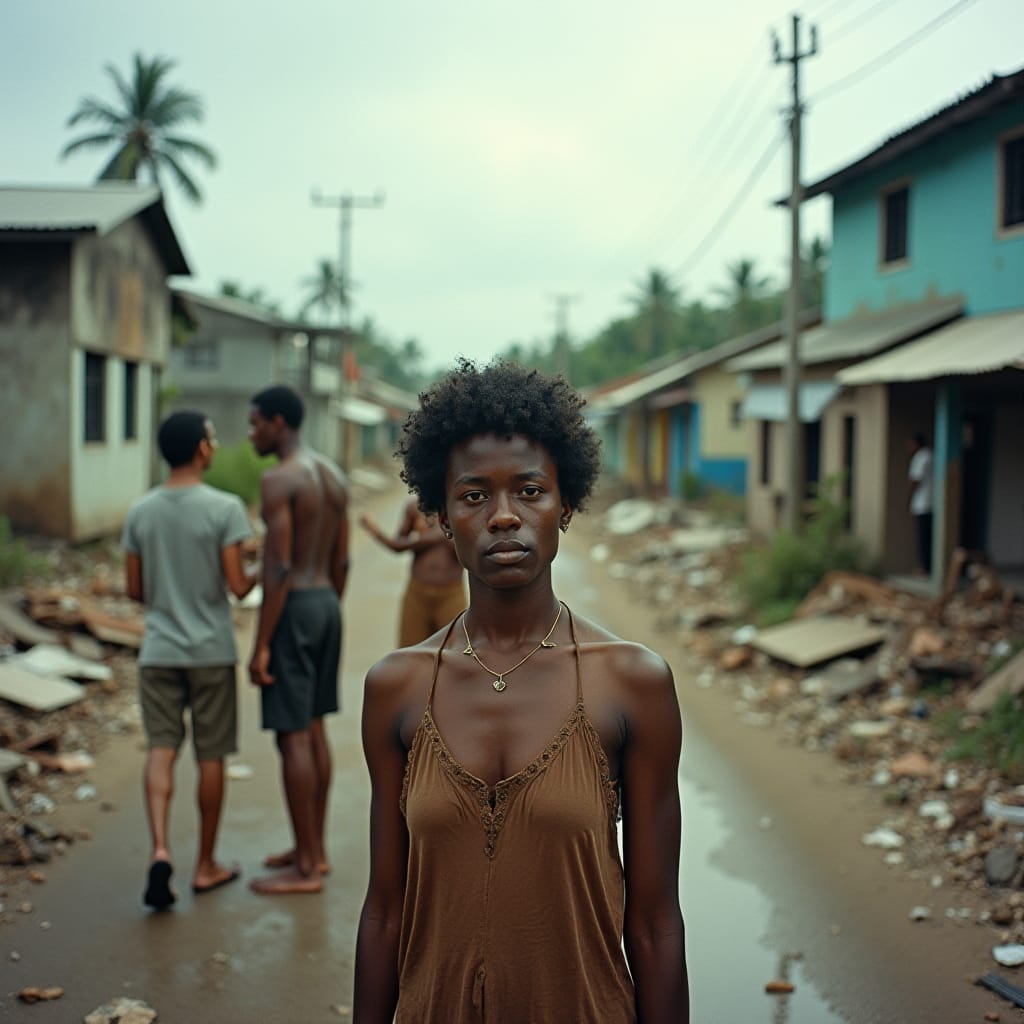
There are moments in a nation’s story when the landscape itself seems to sigh — as if exhausted by the weight of human neglect. Hurricane Melissa was one such moment. It didn’t simply pass through Jamaica; it unstitched her seams.
Before the storm, there was the hum of daily life: the chatter in the shops, the soft hum of generators in the distance, and the hopeful rhythm of a country preparing for yet another weather warning. We’ve had storms before — fierce, defiant ones. But this was different.
When Melissa arrived, it came not as a visitor, but as an uninvited force of nature — 185 miles per hour of raw, indiscriminate power. Roofs were torn away like scraps of paper. Windows imploded. Trees — centuries old — snapped like brittle matchsticks. And in some communities, it was as though a nuclear blast had erased the very idea of home.
In Westmoreland, Black River, and Treasure Beach, locals speak of “ground zero.” Streets where 80 to 90 percent of the roofs are gone. The skeletal remains of houses stand exposed to the rain, their interiors now open-air rooms under the sky.
And yet, amid this ruin, the resilience of Jamaicans endures. People still wave to each other through the chaos. They still laugh. They still play dominoes while a river runs down the road. There is something profoundly moving about a people who can still find rhythm in ruin.
But beneath that warmth is something else — a question.
How did it come to this?
Disconnected in Every Sense
When the power went, so too did the internet. First Digicel, then Flow. Within hours, a nation that had been connected to the world — even during the storm — fell silent in areas.
Phones stopped ringing. Cards machines stopped working. Shops stopped taking payments. It was as if someone had switched off the 21st century.
Without power, without connectivity, even the simplest acts became impossible. You couldn’t buy water or food without cash. You couldn’t call your family to say you were alive.
It’s easy to take modern life for granted — until it fails.
As I went out to find a generator, I found none. Every one was sold out. My house’s line was down, and so was the main community wire. We cut our way through fallen trees just to reach the main road.
The digital blackout has been, in many ways, more crippling than the physical destruction. Jamaica has been pushed, suddenly and violently, back into the dark ages in alot of areas.
And yet, the irony is that everything worked for nearly a day after the storm. The networks held firm through wind and rain — and then, once the skies cleared, they failed. A delayed collapse. A silent one.
This, if anything, proves our point: resilience is not about survival during crisis — it’s about recovery after it.
When Buildings Fail, Systems Fail
As someone who has spent over two decades in construction, design, and management — from Parliament’s secure estates in London to multi-million-pound commercial and educational projects — I’ve learned that resilience is not a luxury. It’s a discipline.
The uncomfortable truth is this: many of Jamaica’s buildings were never ready for a storm like Melissa. And while no structure is ever truly “hurricane-proof,” we can certainly make them hurricane-resistant.
Hurricane straps — those small, unassuming metal connectors that anchor roofs to walls — should already be a legal requirement in Jamaica. In hurricane-prone regions like the United States and the Cayman Islands, their use isn’t optional; it’s mandated by law and rigorously enforced through building codes designed to save lives. They keep roofs anchored when the winds rage. But here, their use is inconsistent. Too often, affordability trumps safety.
And even when straps are installed, we’ve seen that at 185 miles per hour, a roof can still be peeled away like the lid of a tin can.
So, where do we go from here?
For government buildings, schools, and hospitals, it’s time to go beyond straps. Reinforced concrete roofs — heavier, sturdier, less likely to vanish in the night — should be the standard. Not just a recommendation, but law.
This isn’t an impossible dream. It’s a necessary one.
A Call for Structure — and for Soul
Everywhere I go, I see the same problem: short-term thinking. We patch, we plaster, we rebuild — only to lose it again in the next storm.
The government talks of plans. Telecoms speak of upgrades. But talk is not the same as delivery.
We need to build systems with foresight, not just buildings with hindsight. That means policy, enforcement, and incentives. It means municipal inspectors with the authority to halt unsafe construction. It means grants or tax relief for homeowners who build to resilient standards.
And yes, it means treating digital infrastructure as national infrastructure — every bit as vital as roads, bridges, or hospitals.
A connected country is a prepared country. When the networks fell, people weren’t just disconnected from the internet — they were disconnected from help.
Imagine a national network powered by solar and backed by redundant satellite coverage. Imagine local resilience hubs with backup power and communications — community shelters that double as information centers when disaster strikes.
This isn’t fantasy. It’s already happening in places like Puerto Rico and Dominica. We can learn from them — or we can keep learning the hard way.
Rebuilding the Nation, Reimagining the Future
There’s another conversation that must happen — about infrastructure planning.
When both of Jamaica’s major airports shut down, we were left isolated. That’s not resilience — that’s vulnerability.
Extending Ian Fleming International Airport to handle larger aircraft isn’t a vanity project. It’s strategy.
Three international airports in three strategic locations — that’s how a small island becomes a strong nation. If two are down, one can still function. It’s about keeping trade alive, keeping supplies moving, keeping hope in the air.
And as we think of airports, we must also think of homes. It’s time for a national resilience programme — one that helps ordinary Jamaicans retrofit their properties for storms. Grants for hurricane straps, micro-loans for concrete upgrades, training for local builders.
This is how we rebuild a nation — not with slogans, but with standards.
The Digital Divide is a Disaster Divider
If Melissa has taught us anything, it’s that digital poverty equals vulnerability.
I’ve long argued that digital real estate is just as important as physical real estate. Connectivity determines opportunity. It determines whether a child can study, whether a farmer can sell, whether a business can recover.
When a nation goes offline, it doesn’t just lose signal — it loses productivity, progress, and peace of mind.
We must invest in solar-powered microgrids, community broadband, and storm-hardened fibre infrastructure. We must stop viewing the internet as a commercial product and start seeing it as a public utility — a right, not a privilege.
Resilience is Not Just Strength — It’s Compassion
But even as we rebuild, we must not lose sight of the human side. Behind every broken home is a family. Behind every downed wire is a child who can’t attend school. Behind every roofless house is a story.
And yet, Jamaicans — in their infinite spirit — find ways to survive with dignity. They dance. They play dominoes. They share what little they have.
It’s humbling. It’s beautiful. But it shouldn’t be necessary.
Resilience must not depend on how much people can endure — it must depend on how much we prepare.
From Reaction to Reconstruction
As a Fellow of the Chartered Institute of Building (CIOB) and a member of the Association for Project Management, I’ve seen resilience built into systems, not slogans. In the UK, in Europe, in institutions like Parliament and Cranfield University, resilience is designed — not improvised.
Jamaica can do the same. We have the expertise. We have the talent. What we need now is willpower — the political courage to plan for a future that doesn’t crumble with every storm.
Because this isn’t just about concrete, steel, or fibre optics.
It’s about confidence. Continuity. Compassion.
The Conversation Starts Now
Jamaica must not wait for another Melissa.
This is our chance — to reform our building codes, modernize our communication networks, and strengthen our social safety nets.
And yes, perhaps even invite innovation — Elon Musk, if you’re listening, Jamaica needs you — not for vanity, but for viability.
We are strong. But strength without structure is fragility.
We are proud. But pride without progress is paralysis.
Now is the time to build a Jamaica that doesn’t just survive the storm — but stands unshaken when it passes.
Because resilience is not just about walls that don’t fall.
It’s about people who don’t give up.
Dean Jones
Chartered Construction Manager | Project Manager | Surveyor | Realtor

+1 (876) 418-2524
Disclaimer
This article reflects the professional views and observations of Dean Jones, Chartered Construction Manager, Surveyor, and Realtor, following Hurricane Melissa’s impact on Jamaica. It is intended for public awareness and discussion on national resilience, infrastructure reform, and digital preparedness. While hurricane straps can significantly reduce roof damage, even properly installed straps may fail under extreme conditions. Therefore, reinforced concrete roofing should be considered a higher standard for government buildings, hospitals, and schools. The views expressed are those of the author and do not necessarily represent the position of Jamaica Homes or its affiliates.
Disclaimer: The accompanying image is illustrative in nature. It is not intended to portray actual persons, properties, or specific events related to Hurricane Melissa or the Black River community.