


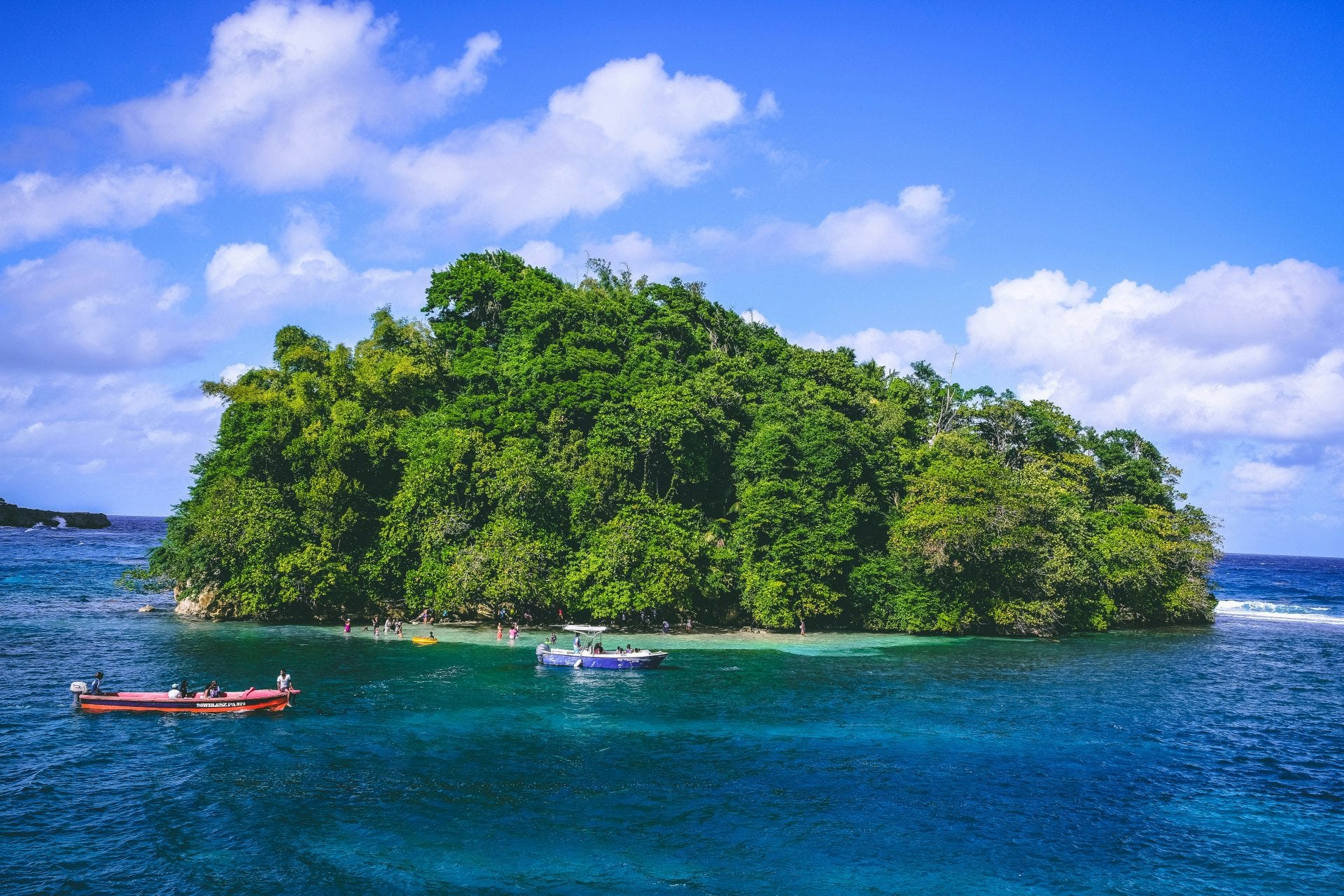
Portland is a parish located on Jamaica’s northeastern coast. The Titchfield Peninsula is lined with homes from the colonial era, and Port Antonio is the modest, relaxed capital. Between the city and the deep seas of the Blue Lagoon to the east, the forested shoreline is ringed with sandy beaches. Bamboo rafts traverse the Rio Grande inland. The Blue Mountains, renowned for their coffee plantations, are traversed by trails.
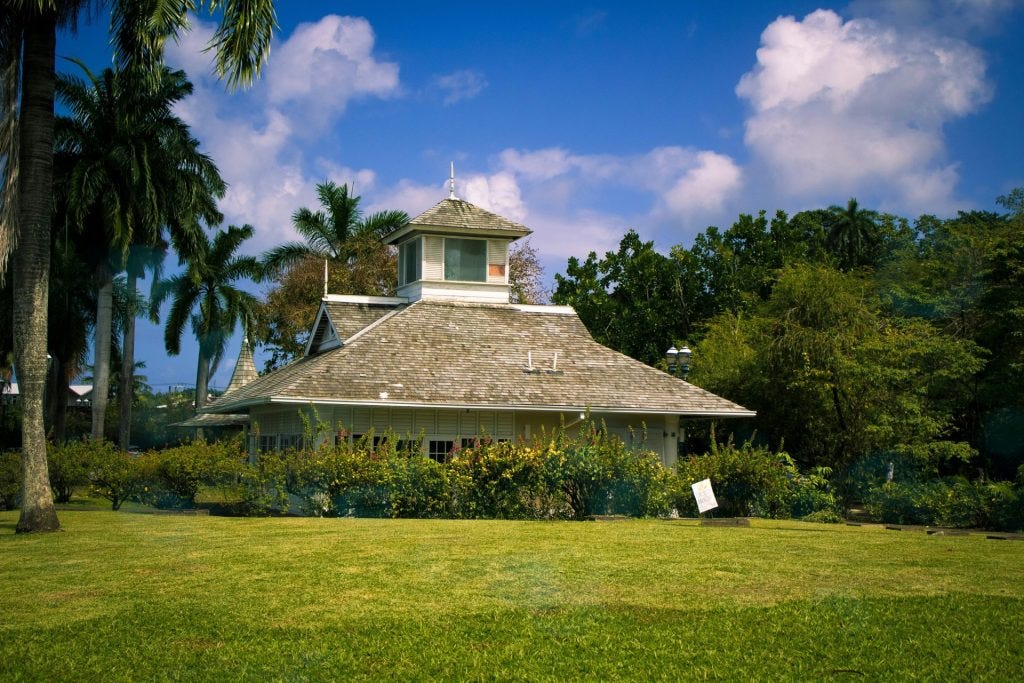
Nestled at the northeastern tip of Jamaica lies the lush and vibrant Parish of Portland, a land steeped in history and brimming with natural beauty. As travelers traverse its winding roads and verdant landscapes, they are met with a tapestry of sights and sounds that tell the tale of a place where the past converges with the present, and every corner holds a story waiting to be discovered.
History Unveiled
Portland Parish formally became a parish in 1723 by order of the Duke of Portland, the then-Governor of Jamaica after whom it is named. The existing port was to be called Port Antonio and was slated to become a naval stronghold. To that end, by 1729, the colonial government began to build Fort George on the peninsula separating the twin East and West harbors known as the Titchfield promontory. The fort was intended to protect settlers from attacks by the Spanish from the sea, and from the Jamaican Maroons who lived in the mountains.
Port Antonio, the capital of Portland, was a settlement first established in Spanish Jamaica, known as Puerto Anton. In the 1880s, Lorenzo Dow Baker started the banana trade in Jamaica and successfully promoted Port Antonio as a destination for wealthy American travelers. “Portie” became a boom town. The banana trade and the tourists who came in the banana boats, was once so large that at one time, weekly sailing from Port Antonio was greater than weekly sailing from the English port of Liverpool.
The island was glamorized by Hollywood as a model of paradise in movies of the 1940s and 1950s, and in later movies such as Club Paradise and Cocktail. This image was added to by the arrival of movie star Errol Flynn in 1946 when his yacht, the Zaca washed ashore in bad weather. He subsequently bought nearby Navy Island, part of historic Fort George in Port Antonio as well as hundreds of acres of farmland along the Portland coast.
Enigmatic Climate and Geographical Location
Port Antonio features a trade-wind tropical rainforest climate under the Köppen climate classification. Like many areas with this climate type, average temperatures vary little throughout the course of the year, with average monthly temperatures roughly at 24 °C (75 °F) throughout the year. The town has a noticeably drier period from February through April, however it has no true dry season month as all 12 months on average easily exceeds 60 millimetres (2.4 in) of precipitation. Port Antonio averages a copious 3,000 millimetres (120 in) of rainfall annually.
Portland is bounded on the north and northeast by the Caribbean Sea, west by St. Mary and south by St. Thomas; the parish covers 89.86km of the island’s total coastal area, while its maximum width is approximately 20.8km. Portland’s coastline stretches from Hectors River in the east to Windsor Castle in the west.
Main Towns and Local Attractions
The two main towns of the parish are Port Antonio, the capital and Buff Bay. Port Antonio is regarded as the cradle of the tourism industry, having been the first town in the country to accommodate tourist visits as a result of the emergence of the Banana Industry. The parish has the distinction of having two harbours and one of its main features is Navy Island, situated on its western harbour. Port Antonio in recent years has been assuming increasing importance as an economic and cultural centre, and it is the hideaway for some of Jamaica’s most exclusive tourist accommodations.
Local Attractions/ Places of Interest
Somerset Falls: Tumbling down the hillsides, Daniel’s River makes a beautiful painting of the landscape. Miniature waterfalls along the narrow gorge add to this awesome scenery, with the mist and the steady rush of water blotting out the outside world.
The Nonsuch Caves: As the popular story goes, these caves were “rediscovered” in 1957 by a goat that seemed to have lost its way. Mother Nature seems to have used her free hand to create similar structures to what man has created to adorn the chambers.
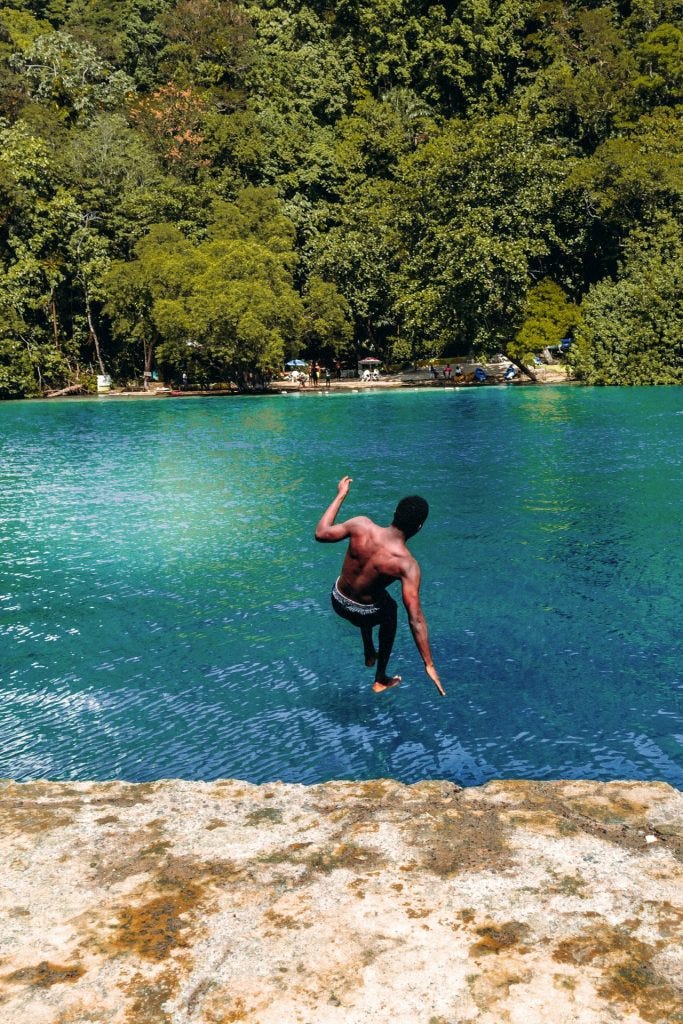
Blue Lagoon: A 55-metre (180 ft) deep extinct volcano, surrounded by lush tropical foliage fed by underground streams feed the Blue Lagoon. In its heyday, this area was famous for water skiing.
Rio Grande: In recent times, rafting on this river has become a great tourist attraction. Rafting starts at Berrydale and continues for about 4 kilometres ending at Rafter’s Rest.
Reach Falls: Situated in Manchioneal, these breathtaking falls are a scenic highlight of the area.
Crystal Springs: This is a recreational centre which boasts 156 acres. Among the facilities offered are fishponds and river, picnic grounds and a garden.
Navy Island: Seven minutes by boat from Port Antonio. Attractions include a guided tour by reservation. There are also cottages and villas, a marina bar, restaurant and white sand beach with water sporting activities.
Titchfield School: The main building of Titchfield was at one time a military barracks, built in 1743 to protect planters against invasion and attacks from the Maroons. Fort George, which overlooks the harbour, was built in 1729. Titchfield was founded in 1786 as a “free” school for the education of the youth of the parish.
Fair Prospect Comprehensive High School: This is the location of the Fair Prospect Windmill Tower. The Tower was used to lift water from an underground source, which is now a dry cave. The tower was converted to a residence; however, the integrity of the exterior of the windmill is maintained.
Seaman’s Valley: This property has on it the ruins of the Seaman’s Valley Great House and the first European cemetery in this area of Portland. Here George Fuller, famous English superintendent of the Moore Town Maroons was buried. The Seaman’s Valley road leads to Moore Town, the oldest settlement of the entire valley, and also to the headquarters of the Eastern Maroons.
Portland is a testament to the resilience, strength, and beauty of the Jamaican spirit. As travelers journey through its verdant landscapes and storied past, they are reminded of the enduring legacy of those who came before and the promise of a brighter future for generations to come. So come, explore the verdant tapestry of Portland and discover the magic that awaits in this timeless corner of Jamaica.
From Ancient Roots to Modern Charms: A Historical Journey Through Portland, Jamaica
Pre-Colonial Era:
Ancient indigenous peoples, including the Taino and Arawak tribes, inhabit the region now known as Portland.
These indigenous communities engage in agriculture, fishing, and trade, establishing a vibrant culture connected to the land and sea.
Spanish Occupation:
In 1494, Christopher Columbus arrives in Jamaica during his second voyage to the New World, claiming the island for Spain.
Spanish colonizers establish settlements and exploit the island’s resources, including gold mining and agriculture.
Spanish control of Jamaica continues until the early 17th century.
British Colonial Period:
In 1655, British forces led by Admiral William Penn and General Robert Venables capture Jamaica from the Spanish.
British colonization brings significant changes to the island’s demographics, economy, and culture.
The British establish sugar plantations, relying heavily on enslaved labor from Africa.
By the early 18th century, the area that would become Portland is part of the British colony of Jamaica.
Formation of Portland Parish:
In 1723, the Duke of Portland, then Governor of Jamaica, orders the creation of the Parish of Portland, named in his honor.
The original parish of Portland encompasses areas previously part of St. George and St. Thomas.
Port Antonio emerges as the main town and port within the newly formed parish.
Maroon Resistance:
Maroons, descendants of enslaved Africans who escaped from plantations, establish communities in the rugged mountains of Portland.
The Maroons resist British authority and engage in guerrilla warfare against plantation owners and colonial forces.
Nanny, a legendary Maroon leader, becomes a symbol of resistance and empowerment for the Maroon communities in Portland.
19th Century Development:
In the 19th century, Portland experiences significant economic growth driven by agriculture, particularly sugar and bananas.
Port Antonio becomes a major hub for the banana trade, with shipments exported to North America and Europe.
The tourism industry begins to develop in Port Antonio, attracting wealthy visitors seeking tropical retreats.
Modern Era:
In the 20th and 21st centuries, Portland continues to evolve as a center of tourism, agriculture, and cultural heritage.
The parish retains its reputation for natural beauty, attracting tourists from around the world to its pristine beaches, lush rainforests, and scenic waterfalls.
Port Antonio remains a popular destination for luxury travelers, while efforts are made to preserve the region’s ecological integrity and cultural heritage.
Today:
Portland stands as a vibrant and diverse community, blending the rich tapestry of its history with the opportunities and challenges of the modern world.
The parish continues to celebrate its cultural heritage through festivals, music, and art, while also embracing sustainable development and environmental conservation.
As tourism and agriculture remain vital to the local economy, Portland looks towards the future with optimism, resilience, and a deep appreciation for its past.